
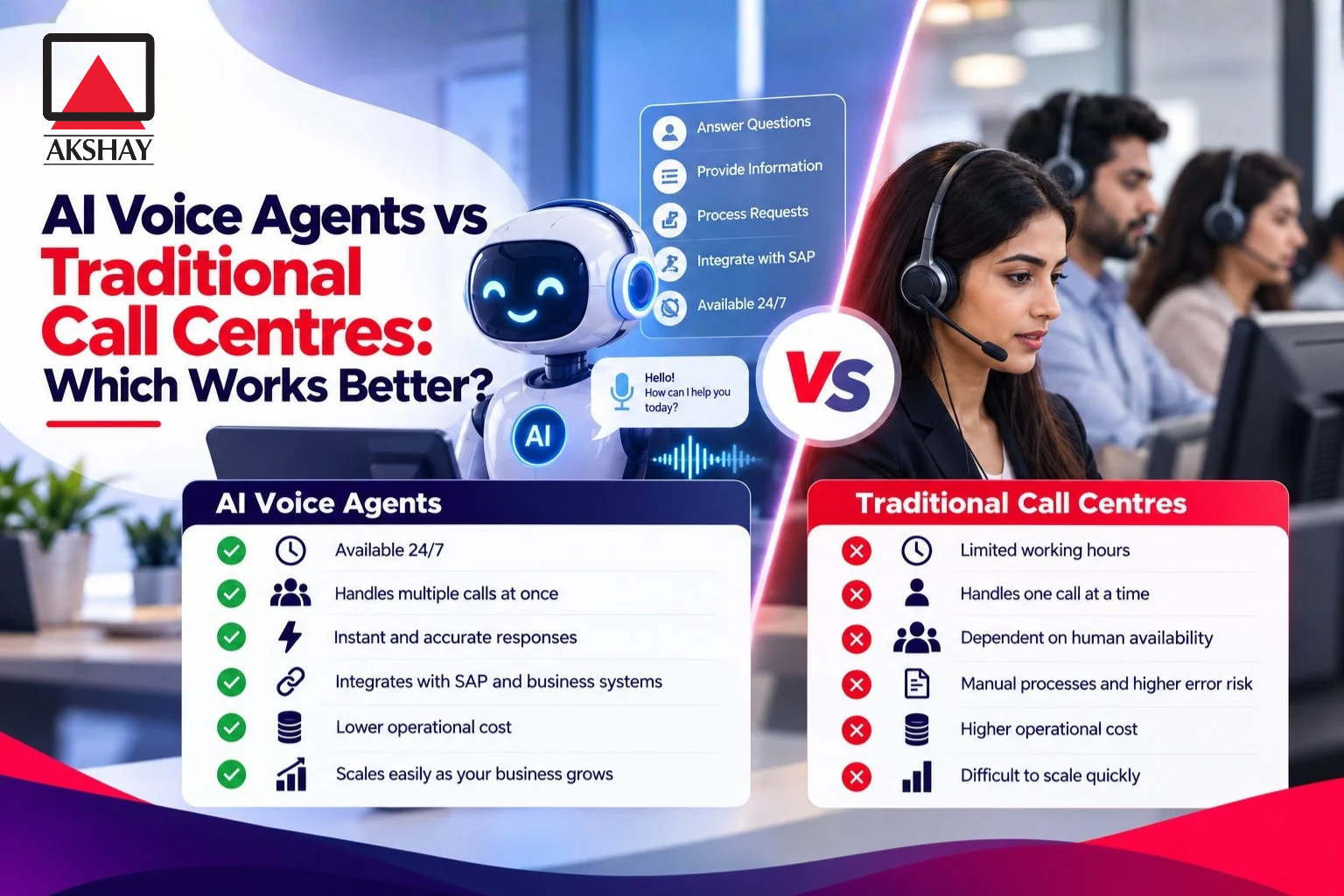
For routine, repeatable calls, an AI voice agent can provide faster, round-the-clock coverage; for a distressing or unusual problem, a human agent is usually the better choice. If you run a business in India, the right fit depends on your call types, operating hours, language needs, and budget for human escalation. A fast answer helps only when customers get useful support and their issues reach the right people.
AI voice agents vs traditional call centres is not a simple choice between new technology and old service. The best option depends on the work your callers need done and the experience you want them to have. You can automate predictable steps and keep people ready for calls that need judgment. That approach can also help you manage service during busy periods without making every customer wait for a person.
Start by sorting your calls into routine, complex, and sensitive categories before comparing solutions.
Key Takeaways
- AI voice agents often fit repeatable calls and continuous coverage.
- Human agents are stronger with complex, emotional, or unusual issues.
- A hybrid model can route routine steps through AI and exceptions to people.
- Test language, customer experience, and human escalation before launch.
- Measure successful resolutions, not just faster answers.
What Is the Difference Between an AI Voice Agent and a Traditional Call Centre?
An AI voice agent listens to a caller, interprets the request, and responds or takes an allowed action, while a traditional call centre relies on people to conduct the conversation. The key difference is who handles the spoken exchange and which tasks that handler can complete. Concurrency means the number of calls a system can handle at the same time.
An AI voice workflow uses speech recognition to turn spoken words into text. A conversational model, built with artificial intelligence, works out what the caller wants and forms a reply. Natural language processing, or NLP, helps software process and generate human language.
Connected business systems can supply account details or accept an update. For example, an agent might check a delivery status, then tell the caller. Its actions should stay within the rules and permissions set by the business.
A traditional call centre has human agents speak with customers, ask follow-up questions, and use their judgment. People can draw on policy, experience, and tone to handle unclear conversations. A human agent normally manages one live call at a time.
An IVR routes callers through recorded prompts and keypad choices. An AI voice agent can accept spoken requests instead, but systems differ in what they can understand or do. A natural-sounding voice does not prove the software can finish a real task.
Some businesses use AI virtual assistants to support customer service across voice and other channels. A customer support virtual assistant may use intent recognition and customer data to guide replies. Check whether a proposed system can complete a real task, not only talk naturally.
AI Voice Agents vs Traditional Call Centres: How Do They Compare?
A business handling routine enquiries around the clock will usually favor AI coverage, while a business dominated by complicated or emotionally charged cases should prioritize people. For the common case, AI voice agents suit repeatable calls, and human agents suit conversations needing judgment. This comparison does not mean every AI system can resolve every call.
The table shows how the main systems handle availability, caller input, and exceptions. An IVR is a menu system, not the same as an AI voice agent. It offers recorded prompts and keypad choices.
| Dimension | AI voice agent | Traditional call centre |
|---|---|---|
| Availability | Continuous when configured | Depends on staffed hours and shifts |
| Simultaneous calls | Software concurrency | Limited by available agents |
| Caller input | Spoken natural-language request | Human conversation, sometimes preceded by IVR |
| Routine workflows | Automated within configured rules | Handled by staff |
| Exceptions | Transfer to a human | Human judgment in the conversation |
The comparison is about the operating model, not a promise of equal performance across vendors. An AI system may answer a question but fail to update a record or confirm the result. A human agent may resolve an exception but still work within limited hours.
For a high volume of simple support calls, software can handle routine steps consistently. For unclear requests or sensitive situations, human agents can weigh context as the conversation unfolds. A handoff matters when the system reaches the edge of its allowed task.
Use the table to shortlist a model, then test it against actual calls rather than feature labels.
How Much Do Call Centres and Voice AI Cost in India?
The available India salary figures provide a useful labor benchmark, but salary alone is not the full cost of a staffed call operation. For a fair comparison, separate base pay from total compensation and other operating costs. Do not treat an agent’s salary as the full price of running a call centre.
What human-agent salary figures show
In 2026, the average base salary for a call center agent in India was ₹233,846 per year. That figure came from 10 salary profiles last updated July 06, 2026. The reported base salary range was ₹194,000 to ₹354,000 per year.
Base salary is not the same as total compensation. An entry-level agent with less than one year of experience earned average total compensation of ₹150,869, based on 26 salaries. An early-career agent with one to four years of experience earned average total compensation of ₹204,878, based on 10 salaries.
These figures describe different measures and groups, so they should not be added together. Your own pay costs also depend on the roles, skills, and shifts your service needs. A team serving callers overnight may need coverage beyond a standard daytime schedule.
Which costs sit outside salaries
A staffed operation also needs hiring, training, supervision, facilities, and shift coverage. Managers must plan schedules, review call quality, and help agents learn new systems. These tasks take time even when call volumes are steady.
An AI quote can include usage, telephony, integrations, implementation, monitoring, and human escalation. Each item changes how the system works and who handles calls it cannot finish. A low software fee may not reflect the labor needed to oversee the service.
Compare the cost per successfully resolved interaction, including the support required when automation cannot finish the call.
Which Model Answers Faster and Stays Available After Hours?
An AI voice agent can answer outside staffed shifts, while a human call centre needs scheduled coverage to do the same. For after-hours access, software can pick up when no agent is on duty. Answer time and time to resolution are different measures.
An AI voice agent can begin an automated conversation as soon as the call connects. A human call centre may place callers in a queue when all agents are busy. Continuous availability still depends on configuration, working phone service, and a path for issues the system cannot solve.
Some voice AI implementations have reduced queue times by up to 50%. That is an upper-end result from some deployments, not a guaranteed outcome for every business. Call mix, system design, and staffing for escalation can affect the result.
A quick pickup does not prove that the caller got the right answer. The system might need several questions to identify the issue, or it may transfer the call after a delay. A human agent may take longer to answer but resolve a complicated issue in one conversation.
Measure the time from call start to answer, then track the time until the customer confirms a resolution. Review calls that end without a clear result, even when the first response was fast. Measure both time to answer and time to a confirmed resolution.
When Do Human Agents Handle Conversations Better?
A caller disputing a serious decision or seeking help in distress needs a clear route to a person, not another automated loop. Human judgment matters most when the next step depends on context or emotion. AI should not replace human judgment in every situation.
People can hear when a customer is upset and adjust their tone, pace, and questions. That can help when a complaint involves a loss, a service failure, or a decision the caller sees as unfair. A calm conversation may matter as much as the answer itself.
Human agents can also consider exceptions to policy. A caller may have a valid reason that does not fit the standard workflow. An AI system can follow approved rules, but it should not make up new ones to appear helpful.
Ambiguous requests create another challenge. A caller may describe a problem without knowing its official name or the right department. Human agents can ask open questions and use the answers to find the right path.
Use these signals to decide when a call should move to a person:
- The caller expresses distress or says the issue feels urgent.
- The request falls outside the approved workflow or needs a policy exception.
- The system cannot confidently identify what the caller wants.
- The caller asks to speak with a person.
Customers should not need to prove that their situation is serious before reaching support. Give agents clear authority to take over and explain what they can do. Let callers reach a human without having to repeat the same request through several menus.
Can AI Voice Agents Scale During Call Spikes?
Software can open many call sessions at once, but the phone connection and escalation team still set practical limits. Peak demand tests the whole service, not just the AI model. Software concurrency is only one limit on simultaneous calls.
In practice, concurrency is the number of calls active at the same time. A human agent normally handles one live call at a time. AI software may support more sessions, but the business must check its actual telephony capacity.
What concurrency means in practice
SIP trunking connects a business phone system to a provider network. The number of allocated telephony channels limits how many voice sessions can run at once. A system with high software concurrency can still fail to connect calls if it lacks enough phone capacity.
Queue design also matters. Callers need a clear message and a safe route when demand exceeds capacity. If the AI transfers calls to people, the size of the human escalation team affects wait times and service quality.
Check these four points before relying on automation during a spike:
- Test expected peak inbound volume with realistic call lengths.
- Verify carrier and SIP capacity for the planned call load.
- Set a safe overflow route when systems or agents reach their limit.
- Test outbound batch limits and opt-out handling.
Where outbound automation needs controls
Outbound batches can create a sharp increase in call attempts. Set limits so the campaign does not overwhelm phone capacity or the team handling replies. Track failed connections and stop the batch if the route behaves poorly.
Run a load test at the expected peak and confirm that callers still have a working fallback.
How Well Do AI Voice Agents Understand Indian Languages?
A language label on a feature list does not show whether the system can understand your callers’ accents and mixed-language speech. Test real speech from the regions and customer groups you serve. One aggregate accuracy score cannot prove equal results across languages, accents, or code-switching.
Ask fluent speakers to place test calls in each language and accent. Use realistic names, addresses, dates, and product terms. Multilingual speech recognition should be evaluated separately by language, accent, and code-switched language combination.
Test each language and accent separately
Hindi speech varies by region, and a model may hear a familiar word differently across accents. Tamil speech needs its own test set, not a score borrowed from another language. Use callers who speak naturally instead of reading only from a script.
Check code-switching and speech-recognition errors
Hinglish callers may switch between Hindi and English during one sentence. That change can cause the system to mishear an account term or miss the caller’s intent. Word Error Rate, or WER, measures speech-recognition mistakes; Character Error Rate, or CER, can suit languages where word boundaries are unclear.
| Test slice | Measure | Failure to watch for |
|---|---|---|
| Hindi with varied accents | WER | Misheard names or numbers across accents |
| Tamil speech | WER or CER | Missed word endings or changed account details |
| Hinglish code-switching | WER | Missed switch between Hindi and English |
Do not judge only the transcript. Check whether an error changes the next action, such as sending a caller to the wrong account or repeating a number. A low error rate can still hide a serious mistake in a critical field.
Have fluent speakers review recorded test calls before enabling a language for customers.
How Should Businesses Measure Voice Support Quality?
A faster conversation is only a success if the customer’s issue is resolved accurately and the caller is satisfied. Measure the outcome, not just the speed of the exchange. A lower average handling time alone can hide calls that were not resolved.
Track measures together and compare them by call type and language. Average handling time, or AHT, counts time spent per interaction. Customer satisfaction, or CSAT, records customers’ reported experience.
| Measure | What to track | What a weak result can indicate |
|---|---|---|
| Resolution rate | Calls resolved during the interaction | Wrong answers or failed workflow steps |
| Repeat contact rate | Customers who call again about the same issue | Unclear answers or incomplete fixes |
| AHT | Time spent per interaction | Long calls or rushed calls without resolution |
| CSAT | Customer rating after support | Friction, poor tone, or unmet expectations |
A major telecom company reported a 35% reduction in call handling time after voice AI deployment. That result describes handling time, not proof of higher resolution or satisfaction. A short call can mean the system solved a simple issue, or that the customer gave up.
Check repeat contacts to see whether callers needed another conversation for the same problem. Compare those results with resolution rate and feedback, not just with the average duration. Break results out by the kind of call and language so one strong group does not hide a weak one.
Review unsuccessful calls and repeat contacts alongside any headline efficiency metric.
Which Calls Should Go to AI, Humans, or Both?
A call’s predictability matters more than its industry label when you decide whether to automate it. Start with the task, then consider what happens when a caller gives an unexpected answer. Automate calls with clear steps and keep people responsible for judgment-heavy work.
Appointment confirmations and routine status checks often follow a known path. An AI voice agent can confirm a time or share an approved update. A human agent is a better first choice for disputes, ambiguous requests, and sensitive complaints.
Some calls start with a simple question but may become complicated. The AI can begin the approved workflow and offer a transfer when the caller needs more help. That lets customers avoid a long wait for routine tasks without blocking access to staff.
Payment calls need extra care. Businesses should account for PCI DSS, the payment card security standard, and avoid exposing card data to an unapproved system. Keep payment steps inside systems that meet the business’s security and compliance needs.
Use this simple routing pattern:
- Use AI for repeatable confirmations and routine status requests.
- Route disputes and sensitive complaints to a human agent.
- Offer transfer when a routine call moves beyond its approved steps.
- Keep payment details within approved payment systems.
Automate the repeatable steps, then preserve a direct human route for exceptions.
How Does a Hybrid Call Centre Work?
In a hybrid setup, AI can handle the predictable opening while a human remains available for the conversation that needs judgment. The handoff should feel like one call, not a restart. The human agent should receive the caller’s context before taking over.
An AI voice agent can collect a name, confirm the reason for the call, or answer an approved routine question. It can then route the caller to a team or transfer the call when the next step needs a person. The transfer should include the details already collected.
Let AI handle bounded first steps
Keep the AI’s first tasks clear and limited. It might confirm an appointment or gather information for a service request. Those steps should not require the system to make a judgment outside its approved role.
A hybrid design can also use agent-assist tools. These tools surface information to a human agent during a call, such as an account note or suggested answer. The person still leads the conversation and decides what to say.
Keep human escalation connected to the call
When the caller needs a human, the system should pass a short summary, the caller’s stated goal, and any completed steps. The receiving agent can then avoid asking the customer to repeat basic details. This can make a stressful handoff easier to manage.
Gartner projected that 73% of customer service organizations would implement agent-assist solutions by the end of 2025. That was a past projection, not a confirmed current adoption rate. It points to interest in tools that help staff during conversations.
Test whether the receiving agent gets the caller’s context before the transfer completes.
What Rules Apply to Commercial AI Calls in India?
Before placing AI-generated commercial calls at scale in India, confirm registration, permitted numbers, recipient preferences, and disclosure requirements. Outbound campaigns need controls before the first call. Use this checklist as a planning aid, not legal advice.
India’s TCCCPR framework governs commercial calls, and businesses or telemarketers must register before making commercial communications at scale. Promotional lists must be checked against the National Customer Preference Register, commonly called the DND registry. Keep records of how the campaign screens its list.
Use the correct registration and number format
Commercial and transactional outbound calls are expected to use authorized, registered telecom number formats rather than ordinary 10-digit mobile numbers. A TRAI amendment released February 12, 2026, restricted the use of 10-digit mobile numbers for commercial communications.
The 140 series is for promotional or marketing calls. The 160 series is for service-related calls from entities regulated by RBI, SEBI, IRDAI, and PFRDA. Cross-selling during service calls using 160-series numbers is prohibited.
Respect preferences, consent, and AI disclosure
AI outbound calls should disclose at the start that the recipient is speaking with an AI-generated voice or automated system. A Digital Consent Registry maintained by telecom service providers is intended to verify commercial-communication consent in real time. Suppression checks should also keep people who opted out off future lists.
Use this five-item launch checklist:
- Complete the required business or telemarketer registration.
- Screen promotional lists against the DND registry and current preferences.
- Confirm the correct registered number series for each call type.
- State at the start that the caller is speaking with an AI system.
- Check consent and suppression records before each campaign.
Described penalties include a 15-day suspension of outgoing telecom services for a first-time offender and disconnection from telecom resources for a year for repeat offenders. Financial penalties described are ₹2 lakh for a first violation and ₹10 lakh for later offences. Treat these as stated penalties, separate from your own risk assessment.
Confirm current requirements with TRAI, your telecom operator, and legal counsel before launch. Verify the exact number series and consent process with the telecom operator before activating an outbound campaign.
How Should Businesses Protect Call Data and Transcripts?
Call recordings and transcripts can contain personal data, so a business should plan their use and protection before switching on recording. Set the rules first, including why the business collects each detail. India’s Digital Personal Data Protection Act applies to personal data processed in AI outbound calling.
That data can include recordings and transcripts that identify a customer. Tell callers what the business records and why, using clear notice. Limit collection to details needed for the service instead of capturing unrelated information.
Give access only to staff and vendors who need call data for their work. Use permissions that match each role, and remove access when a person no longer needs it. Keep a record of who can view or export recordings.
Set a retention period for recordings and transcripts, then delete them when the period ends or the business no longer needs them. A deletion process should cover copies held in connected tools, not only the main storage system. Keep the reason for any longer retention clear.
Review the vendor’s access, storage, and security controls before sending call data to its systems. Ask how the vendor protects data, reports a security event, and handles deletion requests. A vendor setting alone does not settle the business’s legal duties.
Create a process for customer requests about their data. Staff should know where to send a request and how to find the related record. Consent or anonymization alone does not guarantee compliance with data-protection law.
Get legal advice on your role and obligations under the Act. Document who can access call data, how long it is retained, and how it will be deleted.
What Must a Business Connect Before Launch?
A voice agent is only useful in a live support workflow if it can reach the right customer record and send the call to the right destination. Connect the whole task, not just the phone line. Test every system the call depends on, including its failure route.
A CRM lookup can help identify a caller and show the relevant account details. A ticketing record can capture a new issue or update an open case. The AI should only make changes that the business has approved.
A call transfer needs to send the caller to the right team with useful context. Transcript storage should place the record in an approved system with the right access controls. These steps connect the conversation to the work that follows it.
Ozonetel’s 2026 India cloud-telephony guide lists custom, quote-based pricing and 50+ pre-built integrations. Examples include Salesforce, Zoho, HubSpot, Freshdesk, and LeadSquared. These names are examples of systems to check, not an endorsement.
Use this five-item integration checklist:
- Confirm caller identification and the fields used to match a record.
- Check which customer and ticket records the system can access.
- Set the updates the AI may make and block unapproved changes.
- Pass the caller’s goal and collected details during human transfer.
- Store transcripts and audit records in approved locations.
Test the whole workflow, including what happens when a CRM or ticketing system is unavailable.
How Can You Compare Providers and Pricing?
Public cloud-telephony plans offer a reference point, but they do not establish the full cost of an AI voice-agent deployment. Compare like with like, since phone service and AI usage are separate parts of an offer. These public figures are cloud-telephony examples, not quoted AI voice-agent rates.
Published plans can help you understand the range of services offered by phone providers. Their pricing basis may differ by user count, plan type, or payment terms. A listed starting figure does not prove a plan fits your call needs.
Compare published cloud-telephony plan examples
| Provider | Listed plan basis | Starting public figure |
|---|---|---|
| Exotel | Business-phone plans | Start at ₹9,999 prepaid |
| MyOperator | CPaaS plans for 10 users | Start at ₹5,000/month |
| Knowlarity | Voice plans for contact-center tiers | Start at ₹1,999/month |
Separate telephony charges from voice AI
Ask each provider to separate telephony, AI usage, setup, integrations, support, and human escalation in its proposal. This shows which service each charge covers and where extra costs may arise. Check whether support covers the software only or also the call workflow.
Compare plans on the same basis, such as expected call volume, features, and who handles exceptions. A phone plan may offer integrations without including the work needed to connect them. Review the terms before treating any plan as suitable.
Compare quotes only after confirming that they cover the same call volume, features, and support responsibilities.
What Should You Check Before Choosing a Model?
Choose the model that meets your call requirements and gives you a workable way to detect, contain, and correct failures. Readiness matters as much as capability when a customer depends on the service. Do not scale a system before you know who owns its risks and fixes.
Check how the AI handles wrong or uncertain answers. A model may give inaccurate information or fail to understand a caller. Your process should stop the call from moving forward when the system cannot safely complete its task.
Review the training data for gaps that may lead to uneven results across customer groups. Protect personal information and test security controls before launch. Staff should know how to monitor performance and take over when the system fails.
Set clear ownership for model changes, call scripts, and workflow updates. A change that improves one task may harm another. Keep a record of what changed, who approved it, and how the team checked the result.
Check operational risk and governance
The NIST AI Risk Management Framework, or AI RMF, is a voluntary tool for managing AI risk, not Indian law. NIST released AI RMF 1.0 on January 26, 2023, and its Generative AI Profile on July 26, 2024. NIST released a concept note for a Trustworthy AI in Critical Infrastructure profile on April 7, 2026.
A framework can help teams organize risk reviews, but it does not guarantee a safe system. NIST also describes projects that test and evaluate AI, speech, and other technologies. Use the NIST AI measurement and evaluation projects as one reference for testing plans.
Run a pilot against real call types
Run a limited pilot that includes routine, complex, and sensitive calls. Agree on pass and fail measures before the pilot begins. Keep a human fallback available for calls that need help or reveal a system failure.
Use this six-item decision checklist:
- Review the mix of call types and how often each occurs.
- Check language and accent test results with fluent speakers.
- Calculate cost per resolved call, including human support.
- Test whether escalation preserves the caller’s context.
- Review data handling and telecom compliance for the planned use.
- Name who monitors the system and owns changes after launch.
Do not expand beyond the pilot until the team can explain who reviews failures and who is accountable for fixing them.
Conclusion
For most businesses, the best starting point is to automate repeatable calls while keeping human agents responsible for the conversations that need judgment. AI voice agents can support predictable tasks and steady availability. People remain better suited to complex or sensitive discussions.
A hybrid approach fits businesses whose calls include both kinds of work. Map your call types and run a measured pilot with a human fallback before making a wider commitment. Choose one high-volume routine workflow, set clear success and escalation measures, and test it with real customer scenarios before scaling.