
In today’s fast world, companies must change fast to stay alive with ERP Systems. Business Transformation is now a must for leaders. They move from old, slow ways to new, quick methods.
Integrated software platforms are key for today’s businesses. Our ERP Services help break down barriers that slow growth. They give a clear view of operations, helping leaders make smart choices.
Having all data in one place helps teams work better together. This gives companies the edge they need to succeed in a digital world. Using these tools is the start to a strong, ready-for-the-future business.
Key Takeaways
- Digital evolution is essential for maintaining a competitive advantage in global markets.
- Integrated platforms serve as the primary foundation for organizational growth.
- Centralizing data eliminates operational silos and improves decision-making speed.
- Real-time insights allow businesses to pivot quickly during market shifts.
- Unified software solutions foster better collaboration across diverse company departments.
Assessing Business Readiness for Digital Transformation
Starting a journey to modern systems means looking at your business health first. Before new tech, check if your processes can grow with you. True readiness means knowing your current state and future goals.
Evaluating Current Operational Bottlenecks
Many Indian businesses face Operational Bottlenecks that slow them down. These problems come from manual work, broken communication, or old software. Finding these issues is the first step to a better Digital Transformation.
Look at your current tasks to find the time wasters. Spotting these helps you focus on what needs fixing first. Streamlining these workflows is key to getting the most from new tech.
Identifying Key Stakeholders and Executive Buy-in
Change needs everyone’s support, not just tech. Getting Executive Buy-in is vital for budget and support. Without top support, even the best tech can fail.
Start talking to your team early to set expectations. When leaders see how Digital Transformation boosts profits, they’re more likely to help. Clear communication links tech needs with business goals.
| Readiness Factor | Low Readiness | High Readiness |
| Process Clarity | Manual, siloed tasks | Automated, integrated workflows |
| Leadership Support | Passive observation | Active, strategic sponsorship |
| Data Quality | Inconsistent, legacy data | Clean, centralized information |
| Change Culture | Resistance to new tools | Open to continuous improvement |
Fixing Operational Bottlenecks and getting Executive Buy-in sets a strong base for growth. This careful planning reduces risks and makes the transition to new systems smooth.
Defining Strategic Objectives for ERP Systems
Setting clear goals is key to making your tech investment pay off. Before picking any software, leaders must know what success means for their company. Without Strategic Objectives, even top ERP Systems might not meet your expectations.
Aligning Technology Goals with Business Outcomes
The main aim of digital changes is to fix specific problems. Make sure your new tech supports your big business plans. For example, if you want to speed up your supply chain, look for software that tracks inventory and automates buying.
When tech and business goals match, companies get more done. This avoids the trap of buying software for its cool features, not its usefulness. Strategic Objectives should aim for lasting benefits, like cutting costs or better customer service in India.
Setting Measurable KPIs for Transformation
Success is hard to measure unless you set clear goals. By setting measurable KPIs, you can check how well your ERP Systems are doing in real-time. These metrics help you make smart changes as you go.
Track these metrics to keep your change on track:
- Cycle Time Reduction: Watch how fast orders are processed.
- Data Accuracy Rates: See how few errors there are in data entry.
- System Adoption Levels: Check how well employees use the new tools.
- Cost Savings: See how much you save over time.
Setting these goals early helps leaders keep teams focused on results. Treating Strategic Objectives as a living plan fosters a culture of ongoing improvement. This way, your investment keeps driving growth.
Selecting the Right ERP Architecture for Your Organization
Modern Indian enterprises face a big choice between cloud and on-premise setups. Your choice of ERP Systems will shape how your company handles data and growth for years. It’s important to look at your current setup and future goals carefully.
Comparing Cloud-Based versus On-Premise Solutions
Cloud-Based ERP models are fast and cost less upfront. They let teams access data from anywhere, which is great for remote work. Many like it because the vendor handles updates and security.
On-Premise Solutions give you full control over your data. This is good for firms with strict rules or no internet. It costs more at first but offers security and autonomy that some value.
| Feature | Cloud-Based ERP | On-Premise Solutions |
| Deployment Speed | Rapid Implementation | Longer Setup Time |
| Upfront Cost | Low Subscription Fees | High Capital Expenditure |
| Maintenance | Managed by Vendor | Managed by Internal IT |
| Data Control | Shared Responsibility | Full Internal Control |
Evaluating Scalability for Growing Indian Enterprises
Scalability is key for growing businesses. Your software must handle more data and complex tasks as you grow. A flexible system saves you from expensive upgrades later.
For growing Indian enterprises, being able to scale is a big plus. Cloud platforms are great because they let you add more easily without big hardware changes. Choosing a platform that grows with you keeps your investment cost-effective for your whole business life.
Planning the Implementation Roadmap
Creating a solid Implementation Roadmap is key to your project’s success. A clear plan helps you deal with digital changes smoothly. It keeps your daily work going without a hitch.
By setting out each milestone, your team stays on track. They focus on big goals, not just today’s problems.
Establishing a Phased Rollout Strategy
In India, many businesses prefer a phased approach over a big launch. This way, your team can get used to new parts step by step. It lowers the risk of system failures during the change.
Breaking your project into smaller parts helps spot issues early. This approach lets you adjust as you go, based on feedback. Incremental deployment keeps your main business running smoothly.
Allocating Resources and Budgetary Requirements
Knowing your financial and human needs is vital. You must plan your budgetary requirements upfront to avoid surprises. A detailed budget keeps your project on track and prevents extra costs.
You also need the right people for the job. Good project managers and technical leads keep things moving. When resources match your goals, you’re set for growth and success.
Managing Data Migration and Integrity
Switching to a new ERP system needs careful handling of data. Data Migration is more than just moving files. It’s a chance to make your data better. Bad data can cause problems for years if not fixed early.
Cleaning Legacy Data for Seamless Transition
First, get rid of old or useless data. Many companies in India have data spread out in many places. Cleaning your legacy data helps your new ERP work well right away.
Here are key steps to get your data ready:
- Standardize formats: Make sure all data looks the same.
- Remove duplicates: Use tools to find and merge duplicate records.
- Validate accuracy: Check financial data against real audits.
- Archive inactive files: Store old data safely but not in the way.
Ensuring Data Security and Privacy Standards
Keeping data safe during Data Migration is very important. Use strong encryption to keep data safe. Maintaining strict privacy standards also helps follow Indian data laws.
This table shows how different migration methods compare:
| Strategy | Security Level | Data Migration Speed | Risk Profile |
| Manual Entry | High (Human Oversight) | Very Slow | Low (High Error Rate) |
| Automated Scripting | Medium (Requires Testing) | Fast | Moderate |
| Cloud-Native ETL | High (Encrypted) | Very Fast | Low |
Do a detailed check after moving data. Verification makes sure data is safe and complete. This makes a strong base for your digital future.
Customizing ERP Modules for Indian Regulatory Compliance
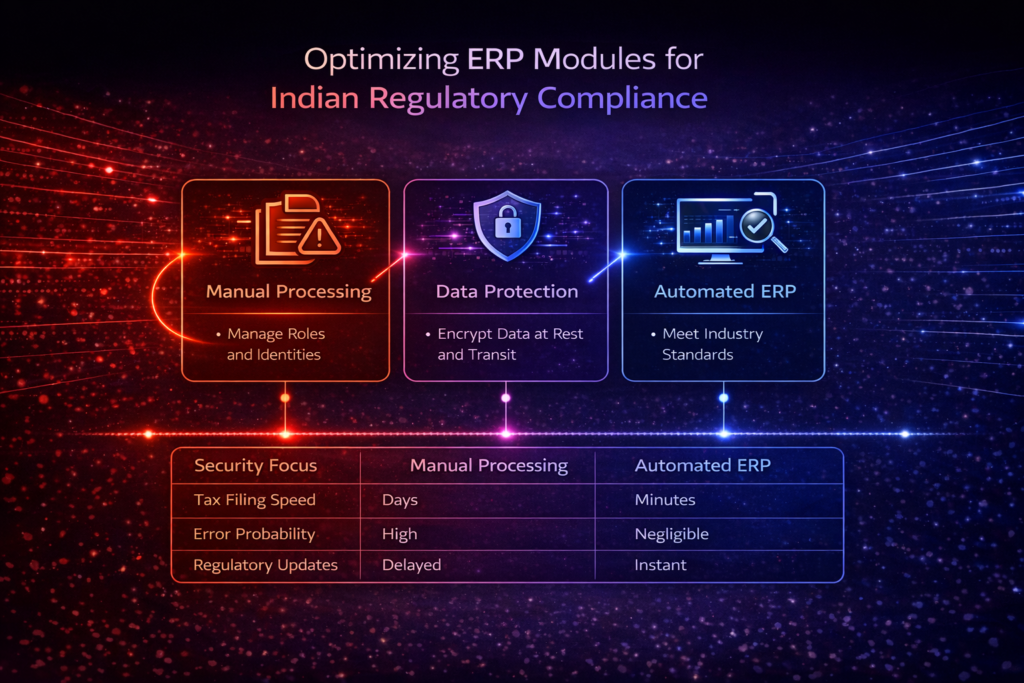
To run smoothly in India, you need to adjust your ERP to fit local laws. Many Indian Enterprises find it hard to mix global software with local rules. By tweaking your main modules, you keep your system flexible and legal.
Adapting Systems for GST and Tax Reporting
The Goods and Services Tax changed how businesses keep track of money. To stay in line with GST Compliance, you need a system that checks data fast and files taxes automatically. Without these changes, you could face big fines and delays.
Today’s ERP systems must connect directly with the government portal. This lets you check invoices right away. It cuts down on mistakes and keeps your tax reports correct all year. Precision in data handling is key for a smooth digital shift in India.
Automating Financial Workflows for Local Regulations
Old ways of handling money can slow you down. Automating these steps lets your team work on big ideas, not just numbers. This is vital for keeping up with GST Compliance in many places.
Here’s why local financial automation is a big plus:
- Reduced Operational Costs: Cut down on the need for manual checks in tax work.
- Enhanced Data Accuracy: Get rid of differences between what you record and what you report to the government.
- Faster Reporting Cycles: Make official reports with just one click.
| Feature | Manual Processing | Automated ERP |
| Tax Filing Speed | Days | Minutes |
| Error Probability | High | Negligible |
| Regulatory Updates | Delayed | Instant |
In the end, Indian Enterprises that focus on these customizations will stand out. A system that gets local rules helps your business grow. Staying ahead of the curve means lasting success and growth.
Training and Change Management Strategies
People are key when moving to new systems. Software helps, but your team makes it work. A good Digital Transformation needs a solid Change Management plan. This plan focuses on getting everyone to use the new system.
Developing Comprehensive Employee Training Programs
Training is more than just showing how to use software. It should be tailored for each role. This way, everyone learns what they need to know.
Here are key parts of a good training plan:
- Role-based modules: Make sure the training fits each job.
- Interactive workshops: Show how things work in real life.
- Ongoing support: Keep a place where people can get help.
- Certification milestones: Give rewards for finishing training.
Overcoming Resistance to New Digital Workflows
Change can be scary. Leaders need to be open about why the new system is better. When people see how it makes their work easier, they’re more likely to go along.
Creating a culture of learning makes people feel strong, not stressed. Share stories of success to keep everyone excited. Here’s how old ways compare to new ones for your company.
| Feature | Traditional Training | Modern Strategy |
| Delivery | One-time classroom session | Continuous digital learning |
| Focus | System features | Business outcomes |
| Feedback | Static surveys | Real-time performance data |
Your effort in Change Management will show in the future. By investing in your team, your Digital Transformation will grow and last.
Integrating Emerging Technologies with ERP
The next step for business software is combining smart data handling with real-world logistics. Today’s companies are moving beyond simple automation. They want to fully use their ERP Systems.
By adding advanced tools to their core, businesses can turn static data into a powerful tool. This makes them more competitive.
Leveraging Artificial Intelligence for Predictive Analytics
Artificial Intelligence is the brain of today’s digital businesses. It doesn’t just record past actions. It predicts future trends with great accuracy.
This change lets leaders make proactive decisions. They can act before market changes hit.
AI looks at past data to spot risks in stock or cash flow. This insight helps Indian companies stay ahead. Predictive analytics turns data into a plan for growth.
Connecting IoT Devices for Real-Time Supply Chain Visibility
Linking physical items to your digital system makes information flow smoothly. IoT sensors bring Supply Chain Visibility to every part of your logistics. Every move of goods is tracked from start to finish.
Live data cuts down on mistakes and delays. When your ERP Systems get updates from the field, managers can plan better. This is key for keeping up in a fast economy.
| Feature | Traditional ERP | Enhanced ERP |
| Data Processing | Historical Reporting | Predictive Analytics |
| Asset Tracking | Manual Entry | IoT Real-Time Monitoring |
| Decision Making | Reactive | Proactive and Automated |
| Operational Scope | Internal Focus | End-to-End Visibility |
Using these technologies needs a smart plan for your setup. Companies that focus on innovation will see their digital systems drive success. Upgrading ensures your business stays strong in a changing world.
Monitoring Performance and Key Metrics
Your journey to digital success doesn’t stop when you launch the software. To keep succeeding, you must always watch and improve. Proactive management is key to getting the most from your investment over time.
Utilizing Dashboards for Real-Time Decision Making
Today’s ERP systems offer great tools for turning data into useful insights. These dashboards help leaders make quick decisions to fix problems as they happen. This quick action is vital for staying ahead in India’s fast business world.
To keep things running smoothly, track important KPIs that match your goals. Focus on these key metrics to keep your system in top shape:
- Inventory Turnover Ratio: Watch how stock moves to improve warehouse work.
- Order Fulfillment Cycle Time: Check how fast orders are filled from start to finish.
- Financial Variance Reports: Compare spending to budgets to control money better.
- System Uptime and Latency: Make sure the tech supports daily needs without delays.
Conducting Post-Implementation Audits
After things settle down, do Post-Implementation Audits to check if the software meets your goals. These audits are like health checks, making sure the software is worth the investment. Rigorous evaluation finds any hidden problems that might have been overlooked at first.
The table below shows how different monitoring methods check if the system works well and meets your strategy:
| Audit Focus | Primary Objective | Expected Outcome |
| Operational Efficiency | Reduce manual workflows | Higher productivity |
| Data Accuracy | Validate input integrity | Reliable reporting |
| User Adoption | Assess training gaps | Increased system usage |
By checking these areas regularly, you keep your digital change on track with market needs. Regular Post-Implementation Audits help you fine-tune and get the most from your ERP.
Scaling ERP Capabilities for Future Growth
As your business grows, your tech needs to keep up. A strong Business Transformation plan makes sure your digital tools help you succeed. This way, you can handle the challenges of the modern Indian market with ease.
Adapting to Market Shifts and Business Expansion
Scalability means your business can handle more work without slowing down. When you start new units or enter new markets, your ERP should adapt easily. Flexibility is key for lasting growth in a fast-changing world.
Planning for Business Expansion ahead of time can save you from old system problems. Using modular architecture lets your software grow with your business. This keeps your team working well, even as your business grows fast.
Continuous Improvement and System Upgrades
Technology keeps changing, and so should your software management. Regular System Upgrades keep your system up-to-date with the latest standards and security. This lets you use new features to make your business more efficient.
Being committed to continuous improvement turns your ERP into a valuable tool. Regular checks and reviews help you make your system better. This way, your investment keeps giving you great value over time.
| Growth Strategy | Primary Benefit | Implementation Focus |
| Cloud Scalability | Rapid Resource Allocation | On-demand capacity |
| Modular Upgrades | Targeted Feature Growth | Departmental needs |
| Performance Audits | System Optimization | Bottleneck removal |
Conclusion
Modern business needs strong tech frameworks. Companies that focus on system implementation are ready for the future. They stay strong in a tough market.
Success is not just about software. It’s about following rules and always getting better. Leaders who use new digital tools grow their business.
Big names like SAP and Oracle help companies change with the times. They give your team the tools to excel. Keep your eyes on the future to make tech pay off.
Start by checking your work processes now. Make sure everyone sees the point of going digital. Your journey to a better business begins with these steps.