
In today’s fast-paced digital economy, businesses across India are rapidly evolving to stay ahead. The shift toward digital transformation requires a flexible foundation that can adapt to changing market demands. At the heart of this change lies a robust IT Architecture, which serves as the blueprint for organizational success.
Modern enterprises rely on scalable resources to maintain a competitive edge in a globalized market. By leveraging a sophisticated Cloud Service Infrastructure, companies can streamline their operations and reduce overhead costs. This approach allows teams to focus on innovation, not managing complex hardware.
Understanding these systems is essential for any leader aiming to build a resilient business. A well-designed framework acts as the backbone of contemporary operations, ensuring that data remains secure and accessible. As we explore these concepts, you will discover how to optimize your technical environment for long-term growth.
Key Takeaways
- Digital transformation is essential for maintaining a competitive advantage in India.
- A solid technical framework acts as the foundation for all enterprise operations.
- Scalable resources allow businesses to adapt quickly to shifting market needs.
- Modern systems help reduce operational costs while boosting overall innovation.
- Security and accessibility remain the primary goals of a well-designed network.
The Evolution of Cloud Service Infrastructure
The move from physical server rooms to digital clouds is a big step in tech. For years, companies used expensive, fixed hardware in local data centers. This old way made growing slow and scaling hard.
From On-Premises Data Centers to Virtualized Environments
Virtualized environments changed how companies use their computers. With hypervisors, they could run many operating systems on one server. This made using hardware better and cut down on energy costs.
Efficiency was the main reason for this change. Companies no longer had to buy new hardware for each app. They could just create new virtual machines. This made them more flexible and able to meet market needs quickly.
The Shift Toward Software-Defined Infrastructure
The industry then moved to Software-Defined Infrastructure. This lets admins control networking, storage, and compute with code. It separates hardware from software management.
This shift made businesses more agile. Automation cut down on mistakes and sped up setup. This change is key to how cloud platforms offer scalable services worldwide.
Core Components of Modern Cloud Architecture
The foundation of any successful digital transformation in India is the strategic selection of core cloud components. A well-designed IT Architecture acts as the backbone for businesses. It ensures that applications remain responsive and secure under varying workloads. By leveraging these building blocks, organizations can achieve unprecedented levels of agility and operational efficiency.
Compute Resources and Virtual Machines
At the heart of cloud infrastructure, compute resources provide the raw processing power necessary to run complex applications. These resources are typically delivered through Virtual Machines (VMs). VMs allow multiple operating systems to run on a single physical server. This virtualization layer ensures that hardware is utilized to its maximum while maintaining strict isolation between different workloads.
Enterprises can scale their Virtual Machines up or down based on real-time demand. This flexibility is a major advantage for Indian startups and large corporations alike. It eliminates the need for expensive, idle hardware. By optimizing compute resources, companies can significantly reduce their operational overhead while maintaining high performance.
Storage Solutions and Data Persistence
Reliable storage is essential for maintaining data integrity in a distributed environment. Modern cloud providers offer various tiers of storage. These range from high-speed block storage for databases to cost-effective object storage for backups. Data persistence ensures that information remains intact even when virtual instances are stopped or restarted.
Choosing the right storage solution depends on the specific needs of the application. For instance, high-transaction databases require low-latency storage. While archival data can reside in cheaper, long-term storage tiers. This tiered approach helps businesses manage their data lifecycle effectively and securely.
Networking and Virtual Private Clouds
Networking components bridge the gap between distributed application services, ensuring seamless communication across the infrastructure. A Virtual Private Cloud (VPC) provides a logically isolated section of the cloud. Here, users can launch resources in a secure, private network. This setup allows for granular control over IP addresses, subnets, and routing tables.
By implementing robust network security, organizations can protect their sensitive data from unauthorized access. The following table highlights the key characteristics of these essential cloud components:
| Component Type | Primary Function | Key Benefit |
| Compute | Processing power | Scalability |
| Storage | Data persistence | Durability |
| Networking | Secure connectivity | Isolation |
Understanding Cloud Service Models
Today’s IT uses three main cloud service models for digital growth. Picking the right one helps Indian companies meet their tech needs and goals. This choice helps them manage costs, control, and ease.
Infrastructure as a Service (IaaS) Explained
IaaS gives the basic parts of computing like servers, storage, and networks. It gives maximum flexibility and control over hardware. This is great for companies needing special setups for old apps or complex tasks.
Platform as a Service (PaaS) for Developers
PaaS makes app development easier by managing the environment. Developers can write code without worrying about the tech side. Increased productivity is key, as teams spend less time on tech and more on new ideas.
Software as a Service (SaaS) Delivery Models
SaaS offers software apps over the internet, accessed through a browser. It’s great for seamless updates and working from anywhere. Examples include CRM tools and office suites that don’t need to be installed locally.
| Model | Primary User | Management Level |
| IaaS | System Administrators | High Control |
| PaaS | Software Developers | Medium Control |
| SaaS | End Users | Low Control |
Choosing the right Cloud Service Models keeps your company competitive. Whether it’s IaaS for power, PaaS for developers, or SaaS for ease, each choice affects your future success.
Deployment Strategies for Indian Enterprises
The digital economy in India is growing fast. This is pushing companies to use better cloud solutions. They need to pick the right model for their goals and rules.
Choosing the right path is a critical milestone. It helps companies stay ahead in a quick market.
Public Cloud Adoption Trends in India
Public cloud use is growing fast in India. Big global companies are helping this growth. They offer new ways to save money and get the latest tech.
Agility is key. It lets both new and old companies quickly start new services.
- Increased investment in local data centers by global providers.
- Widespread migration of customer-facing applications to the cloud.
- Focus on pay-as-you-go models to optimize operational budgets.
Private Cloud Security and Compliance
Many Indian companies choose Private Cloud Security for important data. They need to follow strict rules and keep data safe. Keeping data on-premises helps meet these rules and keeps data safe from threats.
Having a strong security plan is key. It protects important data and customer info. Private clouds help create a safe area for these data. This is important for banking, healthcare, and government.
Hybrid Cloud Architectures for Scalability
More companies are using Hybrid Cloud Architectures. This mix offers control and flexibility. It keeps important data safe while using public cloud for busy tasks.
This setup helps systems handle sudden increases in traffic. It keeps performance high. Indian companies can grow their systems as needed.
This versatile framework lets IT teams be creative. It helps them avoid limits of old hardware. A good hybrid model is key for digital growth and staying strong.
Key Considerations for Cloud Service Infrastructure Design
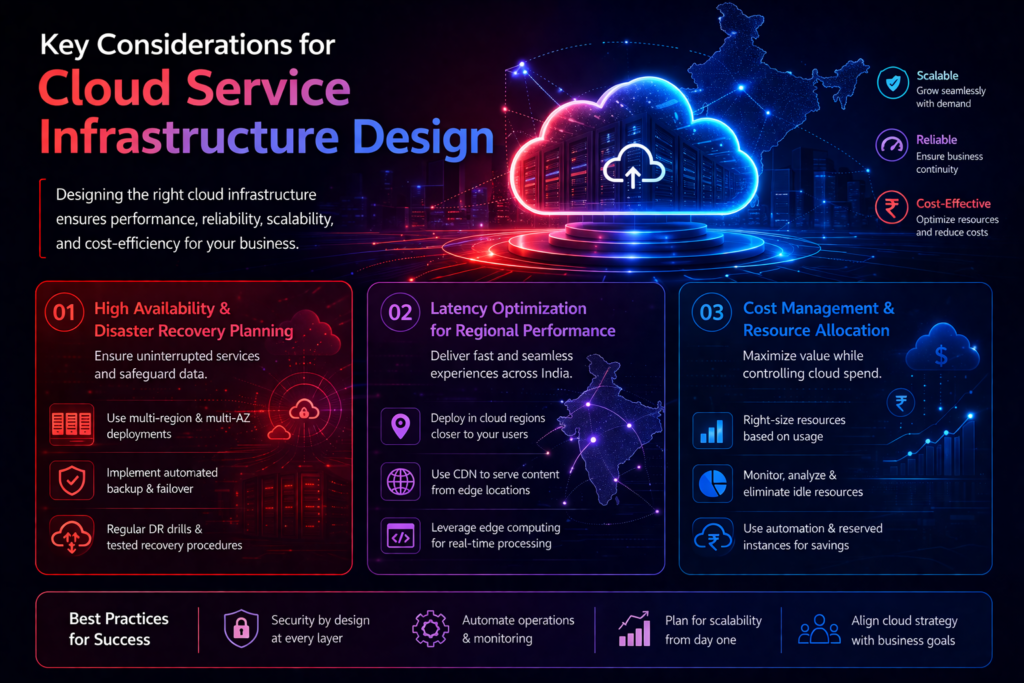
Building a strong Cloud Service Infrastructure is key for growing businesses in India. Architects need to mix technical needs with business goals for success. A good plan helps businesses grow while keeping things running smoothly.
High Availability and Disaster Recovery Planning
Keeping services up and running is very important today. A solid Disaster Recovery plan keeps data safe even when things go wrong. Using data centers in different places helps avoid big problems.
Redundancy helps services stay available. By spreading workloads across different data centers, businesses stay online. This keeps services running for users all over India.
Latency Optimization for Regional Performance
Fast service is key to winning in India. Latency Optimization makes data travel faster. Putting servers close to users makes apps work better.
- Use Content Delivery Networks (CDNs) to store static content near users.
- Choose cloud regions near your main customers.
- Use edge computing to process data locally.
These steps keep your Cloud Service Infrastructure fast, no matter where users are. Fast service builds trust and keeps users happy.
Cost Management and Resource Allocation
Managing resources well saves money without hurting performance. Many struggle with “cloud sprawl,” where unused resources waste money. Regular checks find unused resources and save money.
Using a Disaster Recovery plan with cost-saving tools is smart. It keeps data safe and only charges for what’s used. Smart Latency Optimization also saves money by using the best routes.
Good management of Cloud Service Infrastructure lets Indian companies innovate quickly. By focusing on these key areas, businesses can be strong and cost-effective.
Security Frameworks in the Cloud
Today’s businesses need strong security to fight off cyber threats. Moving important workloads to the cloud means keeping data safe is key. A good security plan uses many tools to protect data everywhere.
Identity and Access Management (IAM) Best Practices
IAM is the first defense in the cloud. It controls who gets to certain resources, lowering risk. Giving users only what they need for their job is called least privilege.
Using multi-factor authentication (MFA) adds a strong layer of security. It stops hackers even if they get your login info. Checking user permissions often keeps your system safe as teams change.
Data Encryption and Regulatory Compliance
Data Encryption is key to keeping data safe. It makes data unreadable, so even if it’s stolen, it’s useless. This is important for following laws like the Digital Personal Data Protection (DPDP) Act in India.
Being compliant is not just about the law; it builds trust with customers. Companies need to manage their encryption keys well. Regular audits help keep them in line with security rules.
Threat Detection and Incident Response
Good Cloud Security means always watching for trouble. Tools that watch network traffic and logs in real-time help. This quick action lets security teams act fast.
Having a plan for when things go wrong is vital. Companies should practice their recovery plans. This way, they can keep running even when hit by big cyber attacks.
Automation and Orchestration in Cloud Environments
Managing complex cloud setups needs a move to automated workflows. In India, as digital growth happens, manual setup slows things down. Automation helps teams do away with boring tasks. It makes sure things work well everywhere.
Infrastructure as Code (IaC) Principles
Infrastructure as Code means managing computing resources with files. It treats infrastructure like software. This way, developers can control their environments like they do with code.
Tools like Terraform or AWS CloudFormation make setting up environments fast. This repeatability helps keep things in line with rules and safety standards. It makes checking changes easy for IT folks.
Continuous Integration and Continuous Deployment (CI/CD)
CI/CD pipelines are key for modern software. They automate testing and deployment. This lets developers update things quickly and confidently.
Removing manual steps makes things run smoother. Automated tests mean only good code gets to users. This helps Indian companies stay ahead in the digital world.
| Feature | Manual Deployment | Automated Deployment |
| Speed of Delivery | Slow and prone to delays | Rapid and consistent |
| Error Rate | High due to human input | Low due to scripted logic |
| Scalability | Limited by manual labor | Highly scalable on demand |
| Consistency | Varies between environments | Uniform across all stages |
The Role of Serverless Computing and Microservices
Indian businesses are changing how they make software. They’re moving away from big, hard-to-change systems. This lets them work faster and be more flexible.
They use Microservices and Serverless Computing to make things better. This helps them do their jobs better.
Decoupling Applications with Microservices
Microservices split big apps into smaller parts. These parts talk to each other through APIs. This way, updating one part doesn’t stop the whole app.
Teams can give more resources to busy parts. This makes things run smoother.
In India, this is key for handling busy times. It keeps apps running well even when lots of people are online. It lets teams work faster and keep things stable.
Event-Driven Architectures and Serverless Functions
Event-driven designs start things only when needed. With Serverless Computing, teams don’t have to worry about servers. The cloud handles it all.
This is great for tasks that run in the background. It lets engineers focus on the important stuff. Here’s how these approaches differ.
| Feature | Monolithic | Microservices | Serverless |
| Deployment | Entire Application | Individual Service | Function-based |
| Scaling | Vertical/Manual | Horizontal/Independent | Automatic/Instant |
| Management | High Overhead | Moderate Overhead | Minimal Overhead |
| Cost Model | Fixed/Provisioned | Resource-based | Pay-per-execution |
Emerging Technologies Shaping Cloud Infrastructure
Innovation in the cloud sector is moving beyond traditional models toward smarter, more localized solutions. As businesses in India scale their digital operations, they need more than basic storage and compute power. The next generation of infrastructure relies on intelligent systems that can adapt to changing workloads in real time.
Artificial Intelligence and Machine Learning Integration
The integration of Artificial Intelligence into cloud platforms is changing how IT teams manage resources. By using machine learning algorithms, providers can predict traffic spikes and adjust capacity before performance drops occur. This proactive approach ensures that applications remain stable even during unexpected surges in user activity.
Beyond simple scaling, these tools help automate complex decision-making processes that were once manual. Organizations can leverage AI to identify security threats faster and optimize energy consumption across massive data centers. This leads to significant cost savings and a more sustainable operational model for growing enterprises.
Edge Computing and Distributed Infrastructure
While centralized clouds handle massive data processing, Edge Computing brings the power of the cloud closer to the end-user. By processing data at the network edge, companies can drastically reduce latency for time-sensitive applications. This is vital for industries like manufacturing and logistics, where every millisecond counts.
Distributed infrastructure allows for a more resilient network that does not rely on a single point of failure. By spreading workloads across multiple regional nodes, businesses ensure that their services remain available even during local network disruptions. This decentralized architecture is the key to supporting the next wave of high-performance digital services across the country.
Conclusion
Modern IT architecture needs a smart plan to stay ahead in today’s digital world. Companies in India must pick the right tech to meet their long-term goals. This is key to lasting success.
Choosing the right deployment models is the first step to growing. Strong security keeps your digital stuff safe and follows local laws. Together, they make a solid base for your data and apps.
Using automation and serverless tech lets your team work on new ideas, not just keeping things running. You can use tools from Amazon Web Services, Microsoft Azure, or Google Cloud to make things smoother. These platforms help you change with the market.
Building a strong cloud environment is a never-ending job. Always check your setup to make sure it’s fast and cost-effective. Talk about your experiences with your IT team. This helps build a culture of always getting better and being technically top-notch.
Contact Us for better Cloud Support and let our experts help you build a scalable and future-ready cloud environment.