

The Indian business world is changing fast. Now, going digital is not just nice, it’s a must to stay alive. Companies that use new tech get ahead in a busy market.
Using cloud service benefits lets companies grow without spending a lot on hardware. It doesn’t matter if you’re a small startup or a big company. These tools help you move fast and focus on what really matters.
Switching to digital is a smart choice for lasting success. With our cloud services, businesses can work better and reach more people easily. This guide will show you how to start and get better at using the cloud.
Key Takeaways
- Digital transformation is key to staying ahead in India.
- Scalability lets startups grow without huge costs.
- Teams work better when they don’t have to manage servers.
- New tech means you can innovate and get products out faster.
- Choosing the right tech helps big companies grow and stay strong.
Understanding the Core Cloud Service Benefits
Cloud services help businesses grow and succeed. They make it easier to handle today’s digital world. By using cloud service benefits, companies can work better and faster.
Operational Efficiency and Agility
Being quick to change is key for today’s businesses. Clouds let you start new apps fast, not slow. This quickness helps teams meet market needs fast.
Using cloud service benefits helps companies do routine tasks automatically. This lets them focus on what really matters. In India, many businesses are moving to the cloud for this reason.
- Rapid prototyping of new software features.
- Seamless integration with existing development tools.
- Instant scaling of resources during peak traffic periods.
Cost-Effectiveness Through Pay-as-You-Go Models
Old IT setups cost a lot upfront. Clouds offer a pay-as-you-go model that changes this. It makes it easier for companies to manage their money.
Predictable billing means you only pay for what you use. This saves money on hardware and server upkeep. It’s a big plus for growing businesses.
Global Reach and Accessibility
Today, businesses can reach anyone, anywhere. Clouds let you serve customers worldwide with low latency. This is key for staying ahead globally.
Clouds make sure your service is the same everywhere, from Mumbai to London. Enterprise cloud adoption means you can serve new markets easily. This way, you can offer great value to clients everywhere.
Assessing Your Business Needs Before Migration
A successful cloud migration strategy starts before moving servers. You need to check your digital assets carefully. This step helps avoid mistakes and makes sure the cloud move adds tangible value to your stakeholders.
Identifying Workloads Suitable for the Cloud
Not all apps are ready for the cloud right away. Sort your workloads by how complex and critical they are. Simple apps can move quickly, but old systems might need big changes to work well in the cloud.
Evaluating Current IT Infrastructure Gaps
Good IT infrastructure optimization means knowing your tech limits. Many Indian businesses face old hardware or data problems. Spotting these issues early lets you use cloud services to fix them and build a stronger system.
Defining Success Metrics and KPIs
You can’t manage what you don’t measure. Set clear Key Performance Indicators (KPIs) to see how your migration affects your business. Focus on things like saving money, improving speed, or keeping systems running. These metrics help show your investment’s worth.
| Workload Type | Migration Complexity | Primary Benefit |
| Web Applications | Low | Scalability |
| Database Systems | Medium | High Availability |
| Legacy ERP | High | Modernization |
| Data Analytics | Medium | Processing Speed |
By using this method, your team can keep your cloud migration strategy focused on business goals. Regular IT infrastructure optimization will make your company more competitive and flexible in the changing Indian market.
Step-by-Step Guide to Selecting a Cloud Provider
Your journey to enterprise cloud adoption starts with choosing the right provider. This choice affects your speed, security, and budget. It’s important to understand what each provider offers.
Comparing Major Providers: AWS, Azure, and Google Cloud
Amazon Web Services (AWS) has a wide range of tools. It’s often the preferred choice for companies needing lots of functionality and global reach. Microsoft Azure works well with Windows environments, fitting many corporate IT needs.
Google Cloud Platform (GCP) excels in data analytics and machine learning. Each provider has unique strengths. Choose based on your technical needs, not just brand.
| Provider | Primary Strength | Best For |
| AWS | Service Breadth | Complex, global applications |
| Azure | Enterprise Integration | Microsoft-centric environments |
| Google Cloud | Data & AI | Big data and innovation |
Analyzing Service Level Agreements (SLAs)
An SLA is more than a legal document; it’s your safety net for uptime. Review the service credits for downtime. Make sure you know what counts as an outage.
Support tiers differ between providers. Check that the SLA offers responsive technical support during your business hours. A good SLA gives you peace of mind during system failures.
Considering Local Data Residency Requirements in India
For businesses in India, data residency India rules are key. Ensure your provider has local data centers to meet legal standards. Keeping data in the country helps with compliance.
Always check where your data is stored. A provider with a strong local presence makes adoption easier. Prioritizing data residency India protects your business from legal and data risks.
Implementing Cost Optimization Strategies
To get a good cloud ROI, you need to watch your spending closely. Businesses should always check if what they spend matches what they get. Good cloud cost management is key to keeping money in your pocket over time.
Right-Sizing Your Cloud Instances
Many companies use too many virtual machines. By looking at past data, you can find out which ones are not used much. Right-sizing means making these resources fit your app’s needs better. This helps a lot with IT infrastructure optimization.
Utilizing Reserved Instances and Spot Pricing
For tasks that happen all the time, Reserved Instances can save a lot of money. On the other hand, spot pricing is great for tasks that don’t need to run all the time. Using both can help keep costs down without sacrificing performance.
Automating Resource Scheduling to Reduce Waste
Managing cloud resources by hand can lead to extra costs when not needed. Setting up automated schedules can turn off unused resources. This simple step helps a lot with cloud cost management.
| Strategy | Best Use Case | Primary Benefit |
| Right-Sizing | Production Workloads | Eliminates Over-Provisioning |
| Reserved Instances | Steady-State Traffic | Predictable Long-Term Savings |
| Spot Pricing | Batch Processing | Lowest Possible Unit Cost |
| Auto-Scheduling | Dev/Test Environments | Reduces Idle Resource Waste |
By using these strategies, your team can make the most of cloud ROI. Keeping your IT infrastructure optimization going is important. Always check and adjust to keep your cloud costs low.
Scaling Infrastructure for Rapid Growth
To achieve scalability for startups, you need to manage resources well. As your online presence grows in India, your systems must adjust to changing needs. Preparation is the key to making a viral product launch a success, not a failure.
Utilizing Auto-Scaling Groups for Traffic Spikes
Auto-scaling groups help your infrastructure grow by adding or removing servers as needed. When more people visit, new servers are added to keep things running smoothly. This keeps your app fast and costs low when it’s quiet.
Implementing Load Balancing for High Availability
Load balancers manage traffic by spreading it across servers. This prevents any one server from getting too busy. With high availability, your users get a smooth experience, even if a server has a problem.
Managing Multi-Region Deployments
For global or India-wide reach, managing servers in different places is key. Hosting data near users cuts down on wait times. It also helps keep services up if a data center goes down.
| Strategy | Primary Benefit | Best Use Case |
| Auto-Scaling | Cost Efficiency | Variable Traffic |
| Load Balancing | System Reliability | High-Traffic Apps |
| Multi-Region | Low Latency | Global Expansion |
Focus on scalability for startups from the start. Using these tools early helps your business grow fast and stay stable in a tough market.
Enhancing Security and Compliance Protocols
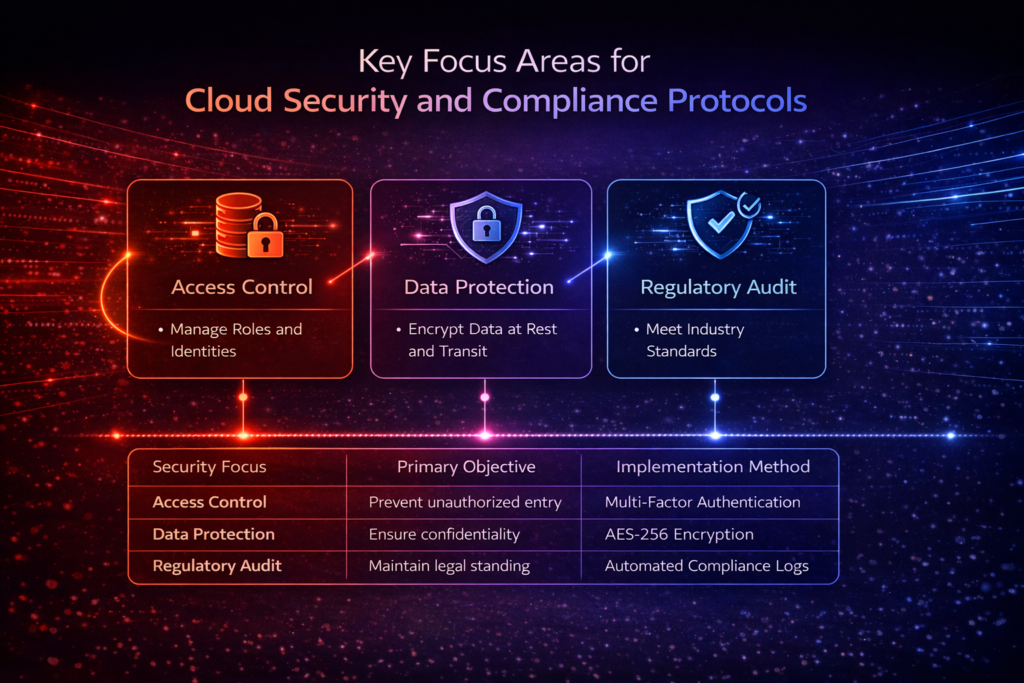
Having a strong security plan is key for a good cloud strategy. Your team must work hard to keep data safe. Using cloud security best practices helps fight off cyber threats.
Implementing Identity and Access Management (IAM)
Good access control is your first defense. IAM tools help you control who can do what. This keeps your cloud safe and organized.
Checking access often stops bad guys. Granular control over roles is key for a secure cloud.
Data Encryption at Rest and in Transit
Strong encryption is needed to keep data safe. It protects data stored and moving. Use TLS for data in transit.
Encryption is a must for keeping data safe. Strong encryption standards make stolen data useless.
Meeting Industry-Specific Compliance Standards
Companies in strict sectors must follow cloud compliance standards. This keeps them out of trouble and builds trust. Follow RBI or HIPAA rules, depending on your area.
The table below shows important security areas for different needs:
| Security Focus | Primary Objective | Implementation Method |
| Access Control | Prevent unauthorized entry | Multi-Factor Authentication |
| Data Protection | Ensure confidentiality | AES-256 Encryption |
| Regulatory Audit | Maintain legal standing | Automated Compliance Logs |
| Network Security | Isolate workloads | Virtual Private Clouds |
Managing Data Migration Without Downtime
Creating a strong cloud migration strategy is key to keeping things running smoothly. Many worry that moving big data will mess up their day-to-day work. But with good planning, you can avoid these problems. This way, your services stay up and running for your customers.
Planning a Phased Migration Strategy
Breaking your migration into smaller steps is a smart move. It lets your team handle things bit by bit, not all at once. This way, you can fix problems fast if they happen. You can test each part separately, making sure everything works before moving on.
Utilizing Data Transfer Services and Tools
Cloud providers have special tools for moving big data safely. For those in India with slow internet, using physical devices is best. These tools keep your data safe by encrypting it while it’s being moved.
Here’s a table showing some top tools for a smooth cloud migration strategy:
| Service Provider | Primary Tool | Best Use Case |
| AWS | DataSync | Automated online transfers |
| Azure | Data Box | Offline bulk data shipping |
| Google Cloud | Transfer Appliance | High-volume, low-bandwidth sites |
Testing and Validation Procedures
Testing is the last step to make sure your data is safe. You need to do comprehensive validation to check if everything works right in the new place. By setting clear goals, you can be sure your cloud migration strategy works as planned.
Leveraging Cloud-Native Tools for Innovation
True digital transformation means more than just moving to the cloud. It’s about cloud-native innovation. Many companies start by moving their workloads to the cloud but keep their old ways. To stand out in India, they need to change how they build and use apps.
Adopting Serverless Computing Architectures
Using serverless computing is a smart move. It means you don’t have to manage servers. This lets developers focus on writing good code, not server upkeep.
With serverless computing, you only pay for what you use. This is great for growing businesses. It makes development faster and more flexible.
Integrating Artificial Intelligence and Machine Learning Services
Cloud providers now have advanced AI and machine learning tools. These tools help your team add cool features like chatbots or predictions. Using these services makes your apps come to market faster.
- Automated insights: Cloud AI can analyze customer habits.
- Scalable models: Grow your machine learning with your data.
- Cost efficiency: Use powerful computing only when needed.
Utilizing Managed Database Solutions
Managing databases takes up a lot of IT time. Managed database solutions take care of routine tasks. This keeps your data secure and always available.
With these solutions, your team can focus on cloud-native innovation. This keeps you ahead while keeping your data safe and reliable.
Training Your Team for Cloud Operations
Your cloud strategy works only if your team knows how to use it. Investing in human capital is key for success in India. Without skilled workers, even top tech won’t work well.
Building a Cloud Center of Excellence
A Cloud Center of Excellence (CCoE) is your team’s cloud guide. It sets standardized best practices for everyone. This way, all teams follow the same rules for security and work.
The CCoE plans your cloud path and picks the right tools. It’s like a guiding light for IT and developers. This keeps things consistent but also lets teams innovate fast.
Upskilling Staff Through Certification Programs
Technology changes fast, so IT pros need to keep learning. Encourage your team to get formal certification programs from big names like AWS and Google Cloud. These programs teach the skills needed for today’s tech.
Certified team members are more confident and skilled. They can fix problems and use resources better, saving money. Prioritizing education keeps your team up-to-date with new tech and security.
Fostering a DevOps Culture
Going to the cloud is a big change, not just tech-wise but also culturally. A DevOps culture makes teams work together better. This means faster and more reliable software.
When teams work together from start to finish, they’re more agile. A strong DevOps culture means everyone works together for better results. This way, your team can use cloud tools to their fullest.
Monitoring Performance and Resource Allocation
You can’t manage what you don’t measure, and this is true for cloud systems. Keeping your digital world healthy needs constant watching and the right tools. By focusing on cloud performance monitoring, your team can spot problems before they affect users.
Setting Up Real-Time Dashboards and Alerts
Today’s cloud tools let you see your setup’s health in real time. Services like Amazon CloudWatch or Azure Monitor help you make dashboards. These dashboards track things like CPU, memory, and network speed. Setting up alerts is key to get your team to act fast when things go wrong.
These steps help teams keep services running smoothly, even when things get busy. By setting up alerts, you save time and focus on fixing problems quickly. Automated monitoring is your first defense against downtime.
Analyzing Cloud Spend with Cost Management Tools
Knowing your spending is as important as knowing your system’s health. Cloud cost management tools give you the details to see where your money goes. This helps you find resources that are not being used and cut down on costs.
| Tool Category | Primary Benefit | Best For |
| Native Cloud Tools | Deep Integration | Real-time monitoring |
| Third-Party Analyzers | Multi-cloud visibility | Cost optimization |
| Budgeting Dashboards | Spending forecasts | Financial planning |
Good cloud cost management lets you track spending by department. Knowing where your money goes helps you make smart choices about scaling or cutting services. Data-driven financial oversight is key for keeping your business stable.
Optimizing Performance Through Continuous Feedback Loops
Managing your cloud setup should always be changing. By using feedback loops, you can keep improving your system. This means looking at reports, adjusting resources, and testing new setups to meet your business needs.
Adding cloud performance monitoring to your DevOps work makes your team better at improving things. When developers and ops teams share data, they can work together to make your system better. Continuous optimization keeps your cloud setup flexible and affordable as your business grows.
Navigating the Indian Cloud Regulatory Landscape
Companies in India are moving fast to digital transformation. They must follow strict cloud compliance standards. The rules keep changing, so businesses need to keep up with data storage and processing.
Managing these laws well is key to a safe and growing cloud strategy.
Understanding Personal Data Protection Regulations
The Digital Personal Data Protection Act has changed how companies handle user data. They must now use strong data governance frameworks. This ensures they are open and responsible with personal data.
Keeping personal data safe is now a big part of doing business. It helps build trust with customers.
Ensuring Compliance with Sector-Specific Guidelines
Some industries have special rules for data residency India. The RBI, SEBI, and IRDAI have rules for finance and insurance. These rules say important data must stay in India.
Companies need to check their cloud setup often. This makes sure they follow these rules. Not following these rules can cause big problems.
It’s important to keep up with these rules. This helps keep services running smoothly.
Working with Local Cloud Partners and Managed Service Providers
Working with local experts makes dealing with Indian rules easier. Managed Service Providers (MSPs) know a lot about local laws. They help make sure cloud services meet Indian rules.
Working with these partners has many benefits for your digital transformation in India:
- Localized Expertise: They really understand local cloud compliance standards and laws.
- Operational Support: They help manage the cloud well, keeping it in line with rules.
- Risk Mitigation: They find and fix problems before they get big.
- Faster Deployment: They help you start up faster with ready-to-go, compliant cloud setups.
Conclusion
Success in business today means keeping up with fast digital changes. This guide shows how to use cloud computing fully. Moving to the cloud is key for staying strong in a tough market.
Working on saving money and always improving helps your team handle tough tech issues. Leaders should make sure their team knows how to use new tech. They also need to follow rules to keep data safe.
By following these steps, your company can grow and change easily. Start your digital change journey by focusing on these important ideas. Talk to your IT team to start making your systems better.