

The world of business is changing fast. Artificial intelligence is now a part of our daily lives. This means modern decision-making processes are changing a lot.
Today’s leaders know old ways won’t keep them ahead. They must use Business Intelligence to stay competitive in a digital world.
Using these smart tools helps companies make fast decisions. This change in Business Intelligence is more than just new tech. It’s a big shift in how companies see value and growth.
Smart leaders know they must keep up with technology. By doing this, your company can handle today’s market challenges better. This means you can make decisions with greater confidence and precision.
Key Takeaways
- Artificial intelligence is changing how companies plan.
- Old ways of analyzing data are no longer good enough in today’s fast market.
- Using advanced analytics is key to staying ahead in the long run.
- Leaders must adopt AI to keep their operations efficient and growing.
- Decisions based on data are now the norm for successful businesses.
The Evolution of Business Intelligence in the Modern Enterprise
Business intelligence has grown from a simple tool to a key asset. Before, companies used static reports to look back. Now, they focus on real-time agility and future plans to stay ahead in India.
From Descriptive Analytics to Predictive Intelligence
Old methods were just about looking at past data. They were good for basic accounting but didn’t offer actionable foresight. Today, predictive intelligence helps guess market changes before they happen.
With advanced machine learning, businesses spot patterns that humans miss. This change lets leaders act before they react. So, companies can better manage their supply chains and inventory.
The Role of Generative AI in Data Democratization
Generative AI has made data democratization easier for everyone. Before, only experts could analyze data with expensive tools. Now, simple interfaces let anyone ask questions like texting.
This change removes old barriers and lets all employees make smart choices. When everyone has access to data, the whole team becomes more agile and innovative. Here’s a table showing the big differences between old systems and new AI ones.
| Feature | Legacy BI | Modern AI-Driven BI |
| Primary Focus | Historical Reporting | Predictive Intelligence |
| User Access | Technical Experts Only | Data Democratization |
| Interface | Static Dashboards | Natural Language Queries |
| Decision Speed | Delayed/Batch Processing | Real-Time Insights |
Assessing Your Organization’s Data Readiness
Many Indian companies face challenges in adopting new tech because their systems are old and broken. To use machine learning, you need to check your digital setup first. A detailed check is the critical first step to make sure your systems can handle today’s fast data needs.
Evaluating Current Data Infrastructure and Silos
The main problem with data infrastructure is the existence of silos. When info is kept separate, it’s hard to see how the company is doing. You need to find these gaps to make sure your models get the right data.
Updating your setup means moving to a central storage system. This helps teams get the insights they need without waiting. Here’s a checklist to see if you’re ready:
- Data Accessibility: Can your teams get to data in real-time from different areas?
- System Compatibility: Does your data infrastructure work with modern API connections?
- Data Quality: Are your records clean, without duplicates or mistakes?
Identifying High-Impact Use Cases for AI Integration
After fixing your base, pick where to use AI for the best results. Not every task needs AI, so focus on areas where it makes a big difference. Tasks that are repetitive and data-heavy are good places to start.
For example, improving supply chain and customer service is key in India. AI can make these tasks faster and better, saving time and money. The goal is to help your team make quicker, smarter choices with good data.
The aim is to match your tech with your business goals. Picking the right projects first helps you grow your data infrastructure across the company. This way, your AI integration starts showing value right away.
Building a Data-Driven Culture for AI Adoption
A modern enterprise thrives when humans and machines work together. Advanced software is the start, but a data-driven culture is key to growth. Without this shift, even the most expensive tools can’t deliver.
Overcoming Resistance to Automated Insights
Employees might worry that automated insights will replace them. Leaders must create a culture of trust and open talk. When people see tech as a helper, not a threat, they’re more open to change.
Building trust means showing how tech makes work better. Highlighting successful projects shows the value of data. This reduces fear and makes teams rely on facts in important meetings.
Upskilling Teams for AI-Augmented Decision Making
Adopting AI-augmented decision making means constant learning. In India, companies are investing in training to fill the digital skills gap. Giving employees the right tools and knowledge helps them understand complex data.
Upskilling is more than just tech training. It’s about solving problems in new ways. When teams use their skills with AI’s insights, they make better, faster choices. This edge is hard for others to match.
| Feature | Traditional Workflow | AI-Augmented Workflow |
| Data Processing | Manual and slow | Real-time and automated |
| Decision Basis | Gut feeling and history | Predictive analytics |
| Team Focus | Data entry tasks | Strategic interpretation |
| Error Rate | Higher human error | Lower, consistent accuracy |
Selecting the Right AI-Powered Business Intelligence Tools
Finding the perfect platform is a balancing act between performance, cost, and security. Making the right technology choice is essential for growth and effective data utilization. For better guidance and support, Contact Us today.
Key Features to Look for in Modern BI Platforms
Today’s Business Intelligence tools do more than just report. They need to handle real-time data processing. This lets teams respond quickly to changes in the market.
It’s also important to have easy-to-use visualization tools. These tools help everyone understand complex data, not just experts.
Strong API support is a must for easy integration. A good platform works well with your CRM, ERP, and marketing tools. This gives you a clear view of your business.
Comparing Cloud-Native Solutions vs. On-Premise AI Models
The choice between cloud-native solutions and on-premise systems is about flexibility versus control. Cloud-native solutions are great for growing fast. They often get AI updates automatically.
On the other hand, on-premise systems give you more control over your data. They are better for companies with strict data rules. Here’s a table to help you choose.
| Feature | Cloud-Native Solutions | On-Premise Models |
| Scalability | High and automated | Manual and hardware-dependent |
| Maintenance | Managed by the provider | Managed by internal IT teams |
| Data Control | Shared responsibility | Full internal control |
| Initial Cost | Lower (Subscription-based) | Higher (Capital expenditure) |
The best Business Intelligence plan depends on your needs and resources. Whether you pick cloud-native solutions or on-premise, the goal is the same. It’s to give your team the best AI insights.
Step-by-Step Guide to Implementing AI-Driven Analytics
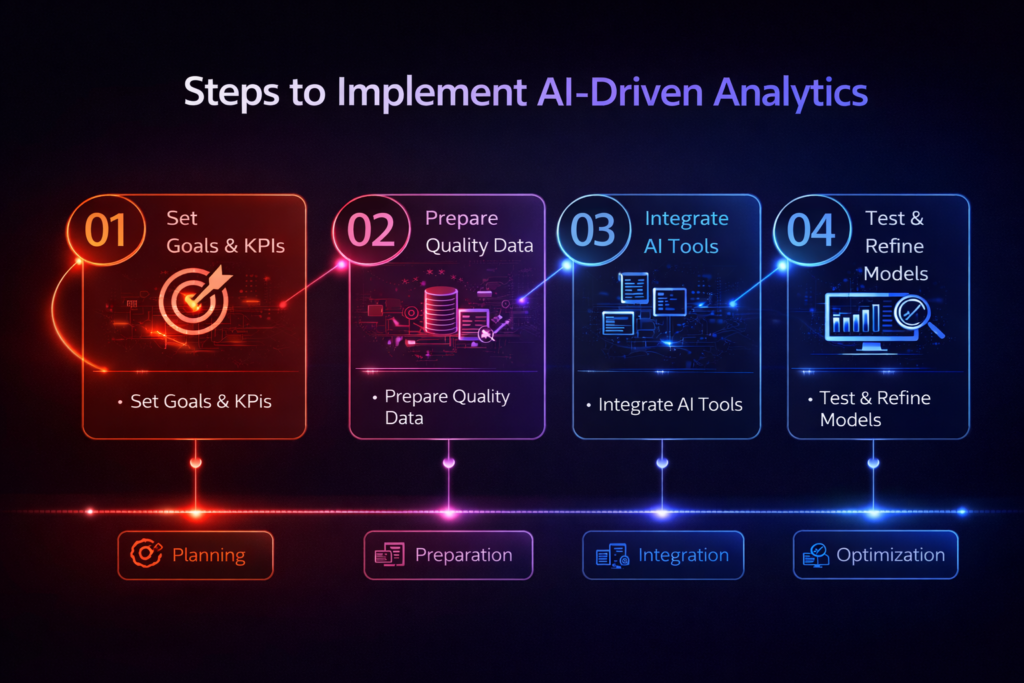
Companies in India are learning that a clear plan is key to using AI well. Moving to AI-driven analytics is more than buying software. It needs a strategy that fits your company’s goals.
Step 1: Define Clear Business Objectives and KPIs
First, set business objectives that add value. Think about what problems you want to solve, like cutting customer loss or improving supply chain. Then, pick KPIs to measure your success.
Step 2: Clean and Prepare Data for Machine Learning Models
Your data’s quality affects your results. Clean and organize it so machine learning models can find useful patterns. This means removing duplicates, fixing missing data, and making formats the same everywhere.
Step 3: Integrate AI Tools with Existing Data Warehouses
Smooth integration is key for one truth. Link your AI tools to your data warehouses for a smooth flow. This lets your team get insights quickly without moving data manually.
Step 4: Pilot Testing and Iterative Model Refinement
Always test before you go big. Start with a small project to test your machine learning models in real life. Use feedback to improve and keep your system up-to-date with business objectives.
The following table outlines the core phases of this implementation journey:
| Phase | Primary Focus | Expected Outcome |
| Planning | Defining business objectives | Strategic alignment |
| Preparation | Data cleaning and hygiene | High-quality datasets |
| Integration | Warehouse connectivity | Unified data flow |
| Optimization | Pilot testing and refinement | Scalable AI-driven analytics |
To keep your project on track, follow these tips:
- Prioritize data security at every stage of the integration process.
- Get input from different teams to make sure AI-driven analytics meet everyone’s needs.
- Keep an eye on how well your machine learning models are doing to avoid losing accuracy.
Ensuring Data Governance and Security in an AI World
In India, businesses are using more artificial intelligence. This makes strong security rules very important. Companies need to see data as a key asset. They must have data governance rules to protect both their interests and customer privacy.
By setting clear rules, companies can create a culture of responsibility. This supports innovation for a long time.
Navigating Data Privacy Regulations in India
The Digital Personal Data Protection (DPDP) Act has changed India’s rules. Leaders must make sure their AI follows these data privacy regulations. This is to avoid legal problems and keep customers’ trust.
Checking data processing regularly is key. Transparency about personal info use builds strong user relationships. Following the law helps avoid data breaches and fines.
Mitigating Bias and Ensuring Algorithmic Transparency
AI’s fairness depends on the data it’s trained on. To be clear, teams must watch for biases. This means testing and using diverse data to make decisions fair for everyone.
Having a way to explain AI decisions helps everyone understand. Ethical AI needs constant checking and human oversight. This way, businesses can use technology responsibly and with integrity.
| Governance Pillar | Primary Objective | Implementation Strategy |
| Data Security | Prevent unauthorized access | Encryption and access controls |
| Regulatory Compliance | Adhere to DPDP Act | Regular legal audits |
| Ethical AI | Reduce model bias | Diverse training datasets |
| Transparency | Explain model logic | Documentation of decision paths |
Leveraging Real-Time Insights for Competitive Advantage
Indian businesses are moving from old ways to new ones. They now use real-time insights to stay ahead. This means making quick changes based on what’s happening now.
Moving Beyond Historical Reporting to Real-Time Forecasting
Old business methods look at what’s happened before. But today’s world needs something faster. Predictive intelligence helps guess what’s coming next.
Using AI-driven analytics is key. It turns data into action right away. No more waiting for reports. Leaders get updates on the fly.
Case Studies of AI-Driven Success in the Indian Market
Many big names in the Indian market have seen big wins. They show how the right tech can grow a business. And make customers happier.
- Zomato: Uses smart learning to cut down delivery times. This makes users very happy.
- HDFC Bank: Finds fraud fast with predictive intelligence. This keeps customers safe and banking smooth.
- Reliance Retail: Manages huge inventories with AI-driven analytics. So, customers always find what they need.
These stories guide other businesses. By focusing on real-time insights, they can tackle the Indian market with ease.
Overcoming Common Challenges in AI Implementation
The journey to successful AI adoption is not always easy. Many leaders face obstacles during the implementation phase. These challenges can slow down progress. But, by knowing what to expect, your team can create a stronger plan for success.
Addressing Data Quality and Integration Bottlenecks
The biggest hurdle in AI integration is poor data quality. If your data is messy or wrong, AI won’t work well. Standardizing your data pipelines is key to getting reliable insights.
To improve your data quality, follow these tips:
- Use automated tools to clean up data and remove errors.
- Create a unified data governance framework for consistency.
- Use centralized data lakes or modern warehouses to break down silos.
Managing Costs and Scaling AI Infrastructure Effectively
As your business grows, so does your data infrastructure needs. Many Indian companies start with a hybrid cloud approach. This helps manage costs by only paying for what you use.
To scale effectively, balance performance with cost control. Regularly check if your AI models are cost-effective. Investing in scalable architecture now saves money later.
| Challenge | Primary Impact | Strategic Solution |
| Data Silos | Fragmented Insights | Unified Data Lake |
| Poor Data Quality | Inaccurate Predictions | Automated Cleansing |
| High Cloud Costs | Budget Overruns | Hybrid Scaling Models |
Proactive planning is the way to overcome these challenges. Focus on clean data and scalable systems. This will help your business succeed in the digital world.
Strategic Frameworks for Long-Term AI Success
To succeed with AI, move from trial projects to a lasting plan. Make sure tech fits with your company’s big goals. Sustainable growth happens when AI is seen as a key part of your business, not just a trend.
Developing a Scalable AI Roadmap
A scalable AI roadmap is your guide for digital change. It shows how to grow from small tests to big use across the company. It helps manage plans and use resources well.
Good roadmaps can change with the Indian market’s fast pace. Aim for quick wins to keep things moving. But also think about growing over time. This keeps your Business Intelligence strong as data grows.
Measuring ROI on AI-Enhanced Business Intelligence
Showing the ROI on AI is key to keep support from all levels. Look at real ways AI helps your profits. See how it makes your business better and more money.
Use a clear way to check how well AI is doing. Compare before and after AI to show its value. Keep an eye on your ROI on AI to make sure it keeps making your business better.
A scalable AI roadmap is always evolving. Keep improving it with new data. This helps your company stay ahead in a tough market.
Conclusion
Today, businesses face a big change. Data is now key for growth. Leaders who focus on learning and good management will lead in India.
Seeing tech as a core idea, not just a tool, is important. This mindset helps businesses grow.
Planning is key for digital change. By linking business goals with AI, companies do more than just automate. They turn data into smart decisions.
Starting your AI journey is easy. Begin with small steps. Build your team’s skills and keep data safe.
Share your ideas on how these steps change your field. Work with your team to build a strong base for future success.