
Handling the EPFO rules in India is tricky. It needs constant focus to avoid fines. Keeping up with rules helps a company’s reputation in a tough market.
Good salary systems make sure staff get paid on time. They also follow ESIC laws. This article looks at how outside help can make these tasks easier for Indian companies. Experts can handle tricky calculations right.
By outsourcing, companies can grow and focus on what they do best. We’ll see how working with experts helps with local rules. This keeps companies ahead in a fast-changing world.
Key Takeaways
- Understand the nuances of Indian labour laws and statutory duties.
- Minimise risks associated with legal non-adherence and penalties.
- Optimise internal resources by outsourcing administrative tasks to experts.
- Improve accuracy in monthly salary disbursements and tax filings.
- Ensure timely updates on changing government regulations and norms.
- Streamline business operations through efficient external intervention.
Understanding Payroll Compliance in the Indian Business Landscape
The Indian payroll compliance scene is complex. It has many rules that businesses must follow. Staying in line with these rules is key to avoiding legal and financial trouble.
What Constitutes Payroll Compliance in India
In India, payroll compliance means following laws about employee pay, benefits, and taxes. This includes correctly calculating and on time paying of Provident Fund (PF), Employees’ State Insurance (ESI), and Professional Tax (PT). It also means keeping accurate records and filing returns on time.
Businesses must also make sure their payroll is clear and can be checked. They need to document salaries, deductions, and allowances well. This keeps them in line and builds trust with employees.
Key Statutory Requirements Under Indian Labour Laws
Indian labour laws cover many employment and pay aspects. Key rules include:
- On time payment of wages and salaries
- Deduction and deposit of PF, ESI, and PT
- Following minimum wages rules
- Keeping accurate payroll records
- Filing regular returns with labour departments
These rules are set by laws like the Employees’ Provident Funds and Miscellaneous Provisions Act, 1952, Employees’ State Insurance Act, 1948, and Payment of Wages Act, 1936.
Financial and Legal Consequences of Non-Compliance
Ignoring payroll rules can lead to big financial and legal problems. These might include:
| Non-Compliance Aspect | Consequences |
| Delayed or incorrect PF/ESI deposits | Penalties and interest on delayed payments |
| Non-adherence to minimum wages | Fines and possible lawsuits |
| Inaccurate or incomplete payroll records | Penalties and legal action |
So, businesses must focus on payroll compliance to avoid these risks and keep operations smooth.
The Growing Complexity of Managing Payroll Compliance In-House
Managing payroll in-house is getting harder. Labour laws and regulations are changing a lot. This makes it tough for businesses to keep up.
Navigating Multiple Central and State Regulations
Dealing with many rules from central and state governments is a big challenge. Indian labour laws mix central and state rules. This includes the Employees’ Provident Funds and Miscellaneous Provisions Act, 1952 and the Employees’ State Insurance Act, 1948.
Each state has its own rules and changes. This makes it hard for businesses in different places to follow the rules. For example, changes in minimum wages and labour laws differ by state.
Key challenges include:
- Understanding and implementing diverse state-specific regulations.
- Managing compliance with multiple statutory requirements.
- Coordinating with various state authorities for filings and returns.
Keeping Pace with Frequent Policy Updates
Keeping up with policy changes is another big challenge. Rules and regulations change often. Businesses must stay updated to avoid breaking the rules.
Frequent policy updates can impact:
- Payroll processing and salary structures.
- Statutory deductions and contributions.
- Reporting and filing requirements.
Resource Limitations and Expertise Gaps
Managing payroll in-house needs a lot of resources and special skills. Many small businesses lack the right setup or staff to handle payroll well.
The consequences of resource limitations and expertise gaps include:
- Increased risk of non-compliance due to errors or oversights.
- Inefficiencies in payroll processing and related administrative tasks.
- Potential legal and financial repercussions.
What Third Party Payroll Management Entails
More businesses in India are choosing to outsource their payroll to third-party providers. This move lets companies use experts to handle their payroll needs well.
Third-party payroll management covers many services for businesses. It’s important for companies thinking about outsourcing their payroll to know what these services are.
Comprehensive Services Offered by Payroll Providers
In India, payroll providers offer a wide range of services. These include handling salaries, keeping up with laws, and filing taxes. They help businesses stay on top of complex rules.
Key services offered by payroll providers include:
- Salary processing and disbursement
- Statutory compliance, including PF and ESIC contributions
- Professional tax and income tax deductions
- Labour law compliance and reporting
- Payroll-related data analytics and insights
The Operational Model of Third Party Payroll Management
The way third-party payroll management works is through teamwork. The service provider and the client work together. This makes sure payroll fits well with the company’s HR and finance systems.
Key aspects of the operational model include:
- Data collection and validation
- Payroll processing and salary disbursement
- Compliance management and reporting
- Ongoing support and query resolution
Different Outsourcing Approaches for Various Business Needs
Businesses have different needs for payroll outsourcing. Some want everything handled, while others just need help with certain parts.
Common outsourcing approaches include:
- Full-service payroll outsourcing
- Selective outsourcing of specific payroll services
- Co-sourcing models that combine in-house and outsourced payroll functions
Knowing the different ways to outsource payroll helps businesses make better choices. This way, they can find the right fit for their needs.
Why Third Party Payroll Management Matters for Your Business
Businesses in India face many challenges with labour laws. Third-party payroll management is a key solution. It helps manage the complex rules and updates to these laws.
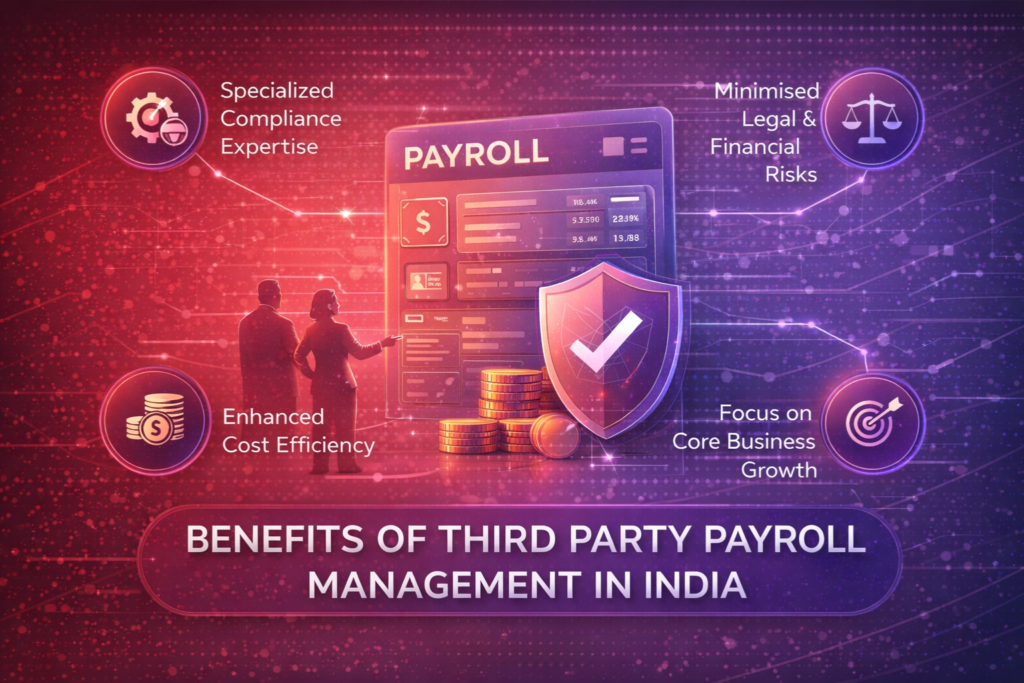
Access to Specialised Compliance Expertise
Outsourcing payroll management offers a big advantage. You get specialised compliance expertise. This means your business stays up-to-date with all laws.
In India, labour laws change a lot. A third-party provider knows these changes. They help your business follow all the rules, like the Employees’ Provident Funds and Miscellaneous Provisions Act.
Mitigation of Legal and Financial Risks
Not following payroll rules can be very risky. Third-party payroll management reduces these risks. It ensures your business follows all laws on time.
By using a third-party, you avoid big fines. They also prevent mistakes in payroll that could lead to legal trouble or financial loss.
| Risk Category | In-House Payroll Management | Third-Party Payroll Management |
| Compliance Risk | High | Low |
| Financial Risk | High | Low |
| Operational Risk | High | Low |
Enhanced Cost Efficiency and Resource Allocation
Outsourcing payroll can save you money. Third-party providers use their scale and expertise to cut costs. This means you don’t have to spend as much on your own payroll team.
This saves you money and lets you use your team better. They can work on things that help your business grow.
Enabling Focus on Strategic Business Priorities
Outsourcing payroll lets you focus on what’s important. You can work on your business goals without worrying about payroll rules. This makes your business grow and innovate.
With a good third-party provider, you can focus on your main work. This improves employee happiness and makes your business more competitive.
Step 1: Assess Your Current Payroll Compliance Status
The first step is to check how well your payroll is doing. You need to look at what’s good and what needs work. This helps improve how you manage your payroll.
Conduct a Comprehensive Payroll Compliance Audit
A payroll compliance audit checks if your payroll follows the rules. It looks at things like how you pay salaries, take deductions, and make statutory contributions.
For a good audit, get help from outside experts. They can give you a fair view of your payroll. They’ll check your records and systems for any problems.
Identify Existing Gaps and Compliance Vulnerabilities
After the audit, find out what’s not right. Look at the audit results to see where you’re not following the rules.
Some common issues are wrong deductions, late filings, and bad record-keeping. Spotting these problems helps fix them and avoid bigger issues.
Document Current Payroll Processes and Systems
Write down how you handle payroll now. This helps you see what’s working and what’s not. Include details on your payroll workflow, software, and team.
Knowing your current setup helps you decide if you need outside help. It also shows what services a payroll provider should offer.
Calculate the True Cost of In-House Payroll Management
Figure out the real cost of doing payroll yourself. This includes direct costs like salaries and software, and indirect costs like HR and finance time.
| Cost Component | Description | Estimated Cost (INR) (per annum) |
|---|---|---|
| Salaries and Benefits for Payroll Staff | Includes the cost of employing staff dedicated to payroll management. | ₹3,00,000 – ₹8,00,000 |
| Payroll Software and Training | Costs associated with payroll software, implementation, and training. | ₹50,000 – ₹2,00,000 |
| Compliance and Audit Fees | Fees paid to auditors and compliance experts. | ₹50,000 – ₹2,00,000 |
| Time Spent by HR and Finance Teams | Opportunity cost of time spent on payroll-related tasks. | ₹2,00,000 – ₹6,00,000 |
| Total Estimated Cost | ₹6,00,000 – ₹18,00,000 |
Knowing the real cost helps you choose wisely. It’s about deciding if you should keep doing payroll yourself or get outside help.
Step 2: Define Your Payroll Outsourcing Requirements
To outsource payroll well, you must know what you need. This step is key to picking the right provider. It helps make sure they meet your needs, boosting the benefits of outsourcing.
Scope and Scale of Services
First, decide what payroll services you need. This means choosing tasks like processing, managing compliance, or filing statutory documents.
Think about your employees, where they are, and how complex your payroll is. Knowing these details helps pick a provider that fits your needs.
| Service Component | Description | Considerations |
| Payroll Processing | Calculates salaries, deductions, and benefits. | Must be accurate, on time, and follow rules. |
| Compliance Management | Follows labour laws and regulations. | Needs to know local laws, file on time, and pass audits. |
| Statutory Filings | Files returns and other documents. | Must meet filing deadlines and formats. |
Establishing Budget Constraints and Expected ROI
Set a clear budget for outsourcing payroll. Understand the costs and what you expect to gain. Look at the fees and any extra charges for services.
Think about the savings, reduced risks, and better efficiency. A detailed analysis helps set realistic goals and make a good choice.
Setting Specific Compliance and Performance Objectives
It’s important to set clear goals for compliance and performance. Make sure the provider follows laws, keeps data safe, and meets deadlines.
Define what success looks like, like accurate payroll, good audit results, and quick customer service. Check these regularly to see how the provider is doing.
Identifying Integration Needs
Lastly, think about if you need the provider to work with your HR or accounting systems. Good integration makes things run smoother and cuts down on mistakes.
Talk to providers about your integration needs. This ensures they can work well with your systems. It makes payroll work better for your business.
Step 3: Select the Right Third Party Payroll Provider
Finding the right third-party payroll provider is key for your business. They help avoid risks, make things more efficient, and follow the rules.
Essential Selection Criteria for Indian Payroll Providers
When looking at payroll providers, think about these important points:
- Compliance expertise: Make sure they know a lot about Indian labour laws.
- Technology and infrastructure: Check if their tech is strong, safe, and can grow with your business.
- Industry experience: See if they’ve worked with companies like yours before.
- Customer support: Check how well they help and how fast they respond.
Critical Questions to Evaluate Provider Capabilities
Ask these important questions to really check a provider:
- What experience do you have with Indian payroll laws?
- How do you keep up with changes in labour laws?
- Can you show me examples of your work with other clients?
- What do you do to keep employee data safe and private?
Verify Compliance Track Record and Industry Experience
It’s vital to check if the provider is good at following the rules and has experience. You can do this by:
- Looking at what other clients say about them.
- Seeing if they have any awards for following the rules.
- Checking if they’ve worked with companies like yours before.
Assess Technology Infrastructure and Data Security Measures
It’s important to look at their tech and how they keep data safe. Think about:
- How they protect your employees’ personal info.
- If their system can grow with your business.
- If they offer tools for real-time reports and analysis.
By looking at these things carefully, you can pick a good third-party payroll provider. They will help your business follow Indian payroll rules.
Step 4: Implement Third Party Payroll Management Successfully
Switching to third-party payroll needs careful planning. It’s key to make sure payroll follows rules and fits with the company’s goals.
Develop a Detailed Transition Timeline and Plan
Creating a detailed plan is the first step. It sets out clear goals, timelines, and who does what. It also includes contingency strategies for any problems.
This plan helps everyone know what to expect. It makes sure the move to the new payroll system goes smoothly.
Execute Secure Data Migration and Validation
Moving data to the new system is very important. It must be done carefully to keep the data safe and correct. This step is critical for avoiding data loss or mistakes.
Data validation checks if the moved data is right. It compares the data with the original to find and fix any mistakes. This keeps payroll running smoothly and avoids legal problems.
Establish Clear Communication Channels and Reporting Protocols
Good communication is key for third-party payroll to work well. It makes sure everyone knows what’s happening. This includes regular updates on payroll and any problems.
Good communication also helps solve problems fast. This keeps payroll running smoothly. The reporting should give quick updates on how payroll is doing.
Train Internal Stakeholders on New Processes
Teaching the team about the new payroll is important. It helps them understand how to work with the new provider. It also shows them their new roles.
Good training makes the team learn faster. It helps them work well with the new provider. This leads to better payroll management.
Step 5: Monitor and Maintain Ongoing Payroll Compliance
Businesses in India must always keep up with payroll rules. They need to manage payroll well and follow all laws. This means being ready for changes in labour laws.
Schedule Regular Compliance Reviews and Audits
It’s key to do regular checks on payroll. These checks help find any problems or things not done right. They also make sure you follow new rules.
- They check if your payroll is working well
- They spot risks and fix them
- They make sure you follow new rules
Doing these checks often helps avoid fines and problems.
Track Essential Compliance and Performance Metrics
It’s important to watch key numbers for payroll. These numbers show if you’re doing well and following rules. Some important ones are:
- How fast and accurate your payroll is
- If you’re taking the right deductions
- If you’re following labour laws
Watching these numbers helps you see where you can get better. It helps you make smart choices.
Maintain Complete Documentation and Audit Trails
Keeping full records is key for showing you follow rules. This includes:
- Payroll records and history
- Reports on compliance and audits
- Records of when rules change
Good records help in audits and checks. They make sure everything is clear and fair.
Implement a Process for Regulatory Update Management
It’s vital to keep up with rule changes. Businesses should have a plan to:
- Watch for new rules and changes
- See how these changes affect payroll
- Make the needed changes to stay compliant
This way, businesses can stay up to date. It helps avoid problems with following rules.
Conclusion
Keeping payroll in line with Indian laws is key for businesses. The rules are complex and hard to follow, mainly for small companies. This is where third-party payroll services are very helpful.
Using a third-party for payroll helps avoid legal and money problems. They bring special knowledge, save money, and let businesses focus on growing.
To keep payroll in check, businesses need to check their current setup. They must know what they need from an outsourced service. Then, they should pick the best provider and make sure the service works well. Lastly, they should keep an eye on how things are going.
By doing these things and using third-party services, Indian companies can manage payroll well. They can also cut down on paperwork and stay within the law.