
Managed SAP Business One support becomes essential as organizations grow and their dependence on efficient business management systems deepens. The way you manage and support these systems can determine whether your operations run smoothly or face costly disruptions. If a single outage has ever halted order fulfilment or delayed financial closures, it’s a clear sign to reevaluate your current support approach.
If your team still reacts to incidents as they occur, consider whether a proactive model would serve you better. SAP B1 managed support combines continuous monitoring, regular maintenance and expert guidance so problems are prevented or resolved before they affect the business. Switching to managed support typically improves system utilization, reduces unplanned downtime and helps you maximize the return on your SAP Business One investment.
This article is for IT managers, finance leaders and operations heads who use SAP Business One and want practical guidance on when to move from reactive to managed SAP B1 support.
Key Takeaways
- How to spot the operational and financial signs that you need a proactive support strategy.
- What benefits managed SAP B1 support delivers — from performance gains to predictable costs.
- How sap business one support services and managed sapb1 support work together to protect systems, data and business continuity.
- A brief readiness checklist and next steps to evaluate sap managed services for your business.
Understanding Reactive vs. Managed SAP Business One Support
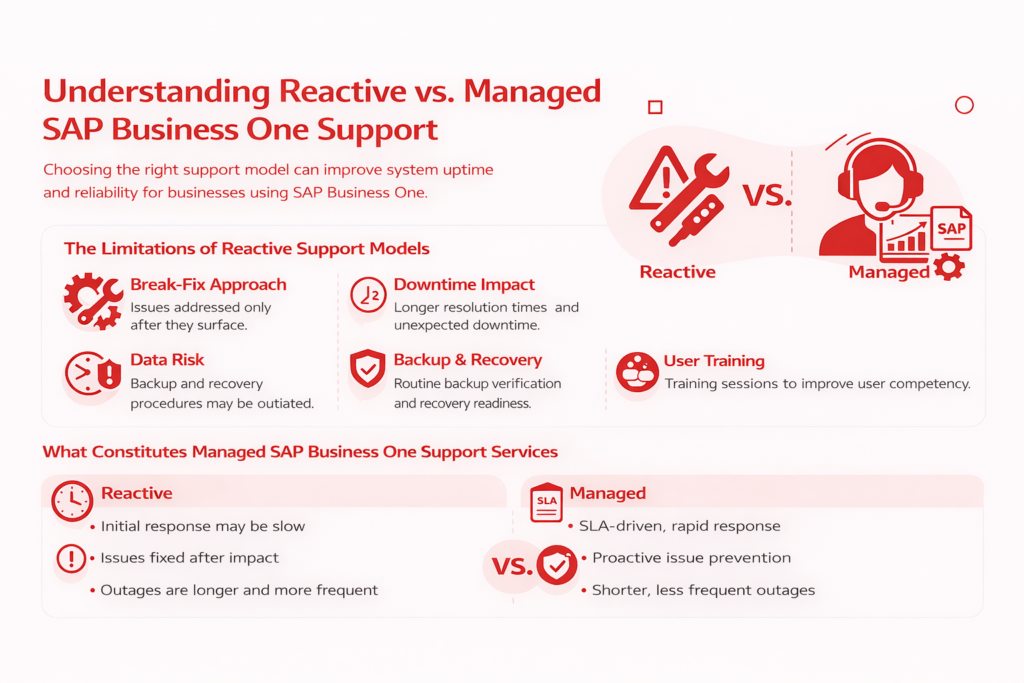
Grasping the difference between reactive and managed SAP B1 support helps businesses choose the right model for their operational needs. SAP Business One is a comprehensive business management solution for small and medium-sized enterprises; ensuring its availability and performance requires more than ad‑hoc fixes.
The Limitations of Reactive Support Models
Reactive support is essentially break‑fix: issues are addressed only after they surface. That often means longer resolution times, unexpected downtime and, in some cases, data risk if backups or recovery procedures are not current. For businesses that rely on SAP Business One for order processing, inventory control and financial reporting, these interruptions translate directly into lost revenue and reduced productivity.
What Constitutes Managed SAP Business One Support Services
Comprehensive SAP Business One support services go beyond ticket handling to provide ongoing, proactive care. Typical managed services include continuous monitoring, scheduled patching and upgrades, regular system health checks, backup and recovery verification, security and compliance management, plus user training and change management. Together these activities keep systems stable, secure and aligned with business needs.
Key Differences in Response Times and Issue Resolution
The most visible differences between reactive and managed approaches are response times and how issues are prevented or resolved. Managed support commonly offers defined SLAs with rapid response for critical incidents (for example, an initial response within an hour for a P1 incident and four to eight hours for high‑priority issues — organisations should validate target times with providers). Because managed providers use proactive monitoring and automated alerts, many incidents are identified and remedied before users notice any impact, reducing both frequency and duration of outages compared with purely reactive support.
Benefits and Signs You Need SAP Business One Managed Support
As your organisation grows, SAP Business One environments typically become more complex — more users, more integrations, larger data volumes and greater reliance on the ERP for core processes. When that complexity outpaces your ability to maintain and optimise the system, the limitations of reactive support become obvious. Moving to SAP B1 managed support is often the most effective way to protect operations, control costs and support growth.
Increasing Frequency of Technical Issues and System Downtime
Frequent incidents — whether application errors, integration failures or slow performance — interrupt order fulfilment, purchasing and financial close cycles. Managed SAP B1 support providers use proactive monitoring and automated alerting to surface anomalies early, so teams can remediate issues before they escalate into business‑critical downtime. In short, a managed approach reduces incident frequency and shortens resolution times, preserving productivity and protecting revenue.
Rising Support Costs and Unpredictable IT Expenses
Reactive support often hides true costs: emergency fixes, overtime, contractor rates and the productivity losses caused by outages. Partnering with SAP B1 support specialists gives you predictable support models — fixed monthly retainers, block‑hour packages or outcome‑based contracts — which make budgeting simpler and often reduce overall cost of ownership. When evaluating vendors, compare pricing models and the scope of services included to understand your likely total cost of support over time.
Limited Internal SAP B1 Expertise and Resource Constraints
Many businesses lack the in‑house skills needed to operate and extend SAP Business One effectively. SAP Business One managed services provide access to a multi‑disciplinary team: functional consultants, technical experts, DBAs and security specialists who understand SAP B1 implementations and integrations. This access fills capability gaps, speeds up implementation and customization work, and frees internal teams to focus on strategic projects rather than daily firefighting.
Proactive Maintenance and Performance Optimization
Proactive maintenance — regular patching, scheduled upgrades, performance tuning and health checks — is a core benefit of managed services. Continuous monitoring highlights bottlenecks (for example, slow queries or memory pressure) and identifies optimisation opportunities such as index tuning, archiving stale data or reconfiguring batch jobs. These activities improve system performance and efficiency, increasing user satisfaction and enabling faster, more reliable operations.
Enhanced Security and Compliance Management
Security and compliance are increasingly important for businesses using ERP systems. Managed support typically includes security patching, backup verification, role‑based access reviews, audit logging and assistance with regulatory reporting. These controls help protect data, demonstrate compliance with standards (such as GDPR where applicable) and reduce the risk of breaches that could damage reputation and incur fines.
Signs you should consider moving to managed services: recurring incidents that affect operations, support costs rising unpredictably, more frequent upgrade requirements, limited internal SAP expertise, or increasing security/compliance obligations. Below is a practical readiness checklist you can use to assess whether your business needs to move from reactive support to SAP B1 managed support.
Managed Support Readiness Checklist
- Incident frequency: Are you experiencing more than a few unresolved tickets per month that affect business processes?
- Downtime impact: Do system outages cause measurable lost revenue or missed SLAs?
- Support predictability: Are support costs volatile (frequent emergency spend or contractor fees)?
- Skill gaps: Do you lack internal SAP B1 expertise for administration, integrations or upgrades?
- Upgrade backlog: Are you delaying essential patches or version upgrades because of limited resources?
- Security & compliance: Are you confident in backup, access controls and audit reporting?
How a Typical Transition Works
Transitioning to managed services usually follows a phased approach: (1) discovery and system assessment, (2) define SLAs and scope, (3) pilot or phased handover, (4) knowledge transfer and documentation, and (5) continuous review and optimization. This staged process reduces risk, preserves institutional knowledge and ensures the support model aligns with your business needs.
Common FAQs
Will managed support replace my internal team? No — it should augment your team by covering routine operations and specialist tasks so internal staff can focus on business priorities.
How is knowledge transferred? Providers should document processes, run training sessions and perform joint support shifts during the handover.
What SLAs should I expect? Typical guidelines are rapid initial response for critical incidents (for example, within an hour) and agreed resolution targets for other priorities — confirm exact targets with prospective providers.
If you want a practical template, download our Managed Support Readiness Checklist or arrange a short assessment call to review your SAP Business One environment and receive bespoke recommendations.
Selecting the Right Managed Support Provider in India
Choosing the right managed support provider in India matters for any organization that relies on SAP Business One to run finance, sales, inventory and reporting processes. A well‑chosen partner helps you transition from reactive break‑fix behavior to a predictable, proactive support model that improves system stability, reduces disruption and supports business growth.
When evaluating suppliers, focus on demonstrated expertise with SAP Business One, clarity of service level agreements and the breadth of support services offered. Look for providers that combine local language and time‑zone coverage with access to experienced sap managed services teams — this hybrid model delivers cost advantages without compromising responsiveness. Confirm that proposals explicitly cover proactive monitoring, patch and upgrade management, backup verification, security controls and user support.
To simplify selection, use a short vendor‑evaluation checklist: (1) relevant SAP Business One certifications and case studies, (2) clear SLAs with response and resolution targets, (3) security and compliance capabilities, (4) flexible commercial models (retainer,block‑hours or outcome‑based) and (5) references from similar industries or enterprise sizes. Ask for example SLA clauses and sample reporting so you can assess likely operational impact and expected cost of ownership.
By partnering with a reliable managed sapb1 support provider you gain a team of experts who handle routine operations, upgrades and incident management while your internal staff focus on strategy. The result is improved productivity, lower support costs over time and stronger business continuity — outcomes that make managed services a practical solution for businesses seeking to optimise their ERP investment in India and beyond.
Next steps: request a short readiness review or download our supplier‑evaluation template to compare vendors side‑by‑side and begin a low‑risk pilot engagement.