
Nearly 60% of high‑intent queries now surface answers on the results page without a site visit. That shift changes how Indian B2B teams win attention.
The practice we call Zero Click Search Optimization reframes seo and marketing as a visibility‑first play. It is about being cited, quoted and surfaced in SERP features such as featured snippets, knowledge panels and AI overviews.
This matters because buyers in SaaS, IT services, consulting and manufacturing often learn from the results page before they click. Winning attention happens earlier in the buying journey, so pipeline influence must work even when clicks and traffic fall.
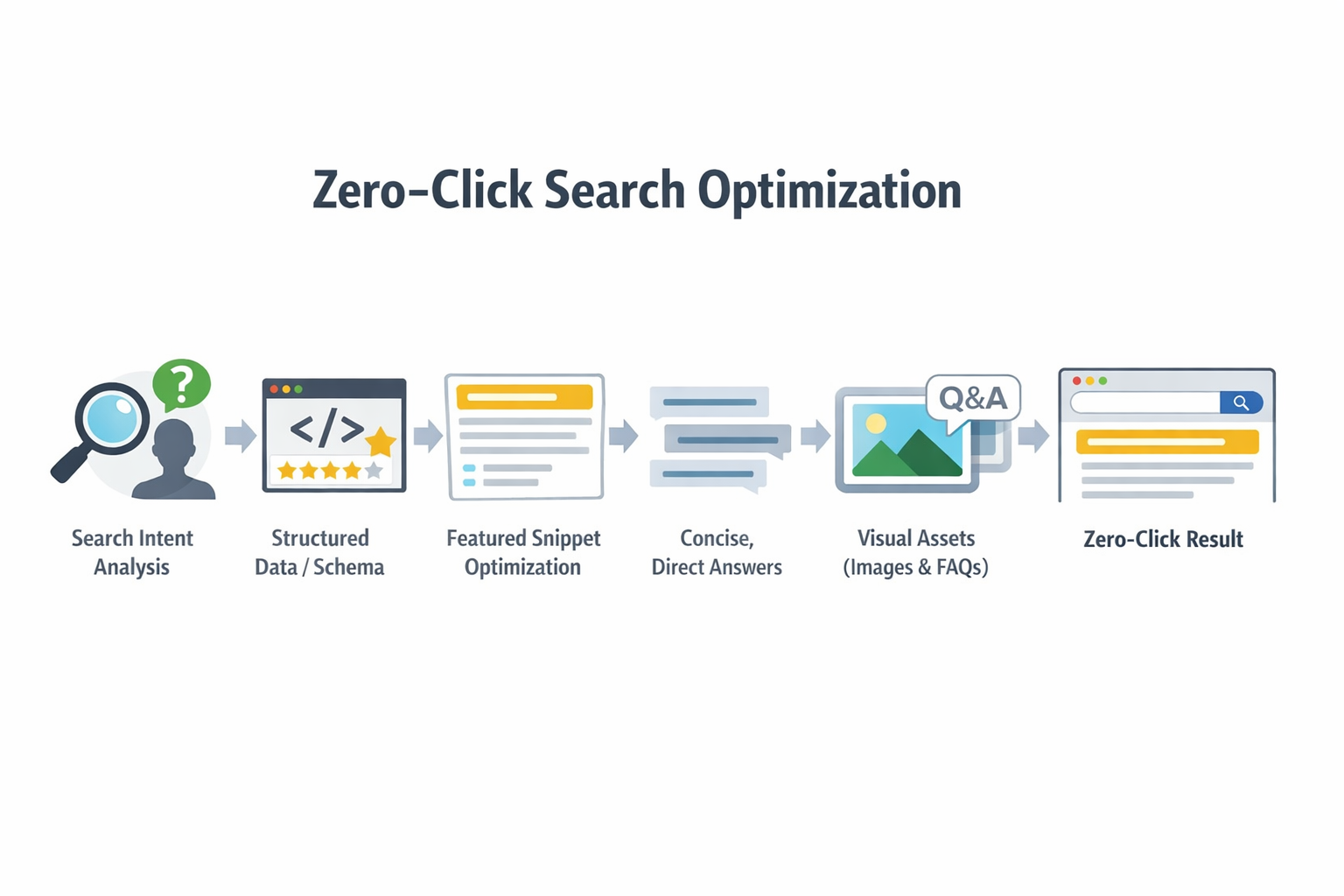
In this article you will get a practical framework: map SERP feature opportunities, re‑structure content for extractability, deploy schema and build topical authority. Success is measured by impressions, mentions and downstream demand signals rather than clicks alone.
Key Takeaways
- Visibility beats clicks when answers live on the results page.
- Focus on being surfaced in SERP features, not only #1 ranking.
- Indian B2B teams can influence pipeline despite falling traffic.
- Implement extractable content, schema and topical authority.
- Measure impressions, mentions and downstream signals, not clicks alone.
Why zero click search is reshaping B2B demand generation in India
Results pages now act as destination points, not just signposts to websites. AI-powered overviews have shortened the path from query to answer and changed how buyers research solutions.
From “search → click → scan” to “search → get answer” with AI Overviews
AI overviews mean many searches end without a site visit. In 2024, 58.5% of U.S. searches and 59.7% of E.U. searches stopped without a click. By March 2025, AI overviews triggered for 13.14% of queries.
What the impressions-up, CTR-down trend means for pipeline influence
One Search Console example showed impressions more than doubled while CTR fell from ~1.5% to under 0.5%. SEO professional Ankush Gupta reported similar patterns when content was surfaced inside AI answers.
- Buyers ask narrower questions and often accept on‑page answers as good enough.
- On mobile-first journeys in India, visibility on the results page wins attention.
- Rising impressions with falling clicks can still boost awareness and assisted conversions.
- Focus reports on impressions, SERP feature presence and branded lift, not sessions alone.
- Citation share becomes a measurable competitive battleground for comparison queries.
| Metric | Before AI Overviews | After AI Overviews |
| Impressions | Baseline | +100% (example) |
| Click-through rate | ~1.5% | |
| Pipeline signal | Sessions-driven | Assisted conversions & brand recall |
What a zero click search is and where your brand can appear on the results page
Users increasingly get the information they need directly on the results page, without visiting a site. This is zero-click content: formatted answers, lists or facts that let a user complete a task on the SERP.
Key SERP spots that expose your brand
Brands can earn visibility without a visit via AI Overviews, featured snippets and knowledge panels. People Also Ask boxes create multiple entry points for related questions.
- AI Overviews cite sources and raise impressions.
- Featured snippets (position zero) give short, scannable answers.
- Knowledge panels reinforce trust with clear brand facts and entity signals.
- People Also Ask expands reach by surfacing related queries and answers.
- Local packs in Bengaluru, Mumbai, Gurgaon, Pune, Hyderabad and Chennai can show maps and contact details, removing the need to click.
- Image and video carousels act as previews that shape brand perception and later branded searches.
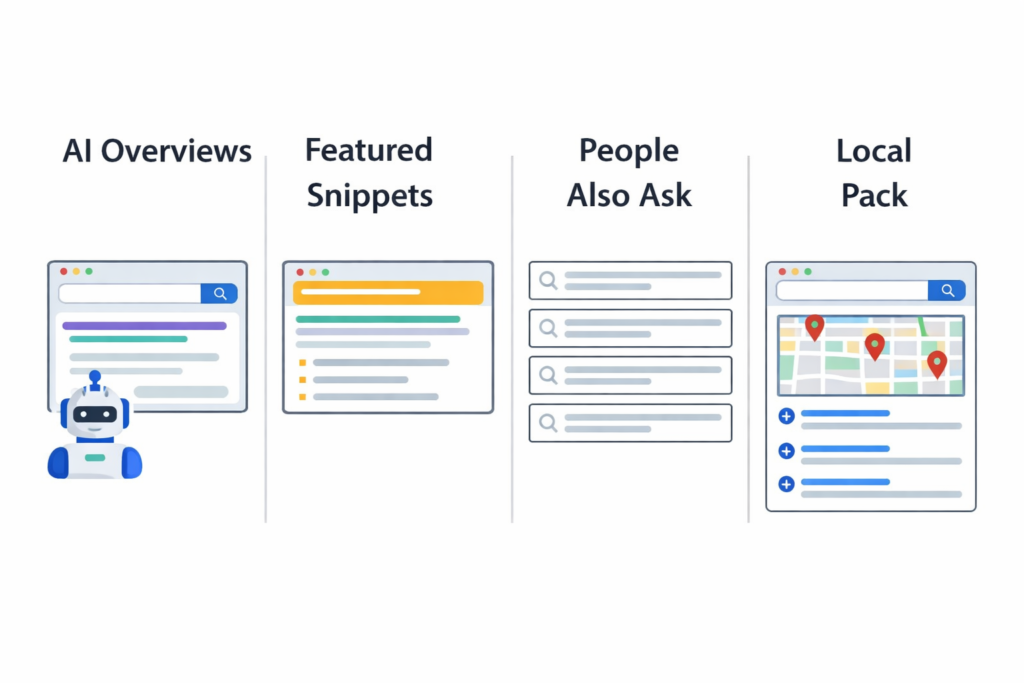
| SERP Feature | How it appears | Why it matters for brands |
| AI Overviews | Summarised answers with source citations | Boosts impressions and citation share |
| Featured snippets | Short definitions, lists or tables at top | Captures intent immediately and builds authority |
| People Also Ask | Expandable question boxes with answers | Multiple chances to appear for related queries |
| Local pack | Map pins and local business cards | Drives local visibility without a site visit |
How AI Overviews and SERP features drive zero-click behaviour today
AI-driven summaries now stitch multiple web sources into a single, scannable answer that often ends a user’s journey on the results page.
These overviews synthesise facts, quotes and lists from several pages. The result: users get the information they need without further exploration. In India, rising mobile use amplifies this effect.
Adoption signals to watch from 2024 to the present
- Rising impressions with steady rankings — more visibility even as sessions stall.
- Declining CTR on informational queries — fewer clicks per set of impressions.
- Increased SERP feature volatility — features appear and shift as AI sources expand.
Why visibility and citation now beat clicks
Informational queries lead the trend, with commercial investigation following as AI summaries improve. For B2B, repeated citations and mentions during an account’s journey often matter more than a single visit.
Align these wins to CRM touchpoints: track assisted conversions, branded query growth and demo requests to prove pipeline impact. Finally, apply source material optimisation—structure content so it can be safely extracted and cited by AI systems.
| Signal | Cause | Practical action |
| Impressions ↑, CTR ↓ | AI overviews surface content on the results page | Optimise extracts (lists, tables, short answers) and track impressions |
| SERP feature volatility | Rapid source rotation by AI models | Maintain topical clusters and refresh authoritative pages |
| Intent shift to zero‑click | Informational queries satisfied on‑SERP first | Prioritise citation capture and CRM linkage for demand gen |
Zero Click Search Optimization versus traditional SEO and AEO
A practical content strategy now balances site experience with formats that AI systems can cite. This shift asks marketers to run two parallel plays: keep pages useful for buyers, and shape extracts that engines reuse.
Different goals, different metrics. Traditional seo measures rankings, visits and CTR. Answer engine work tracks citations and branded mentions. The new approach adds snippet capture, SERP feature share and citation frequency as core KPIs.
How to structure content for both humans and AI
Write a lead-with-the-answer block in the first 40–60 words. Use scannable subheads and a simple layout: definition, context, next step. Provide tables, lists and short step blocks so extracts are usable as answers.
Keep the on-site experience rich despite lower traffic. Add calculators, templates and decision frameworks that a summary cannot replace. Anchor content to your methodology, original data and India-specific constraints to build authority.
| Approach | Primary goal | Key metrics | On-page tactics |
| Traditional SEO | Rank and drive traffic | Rankings, sessions, CTR | Long-form guides, backlinks, keywords |
| Answer Engine Optimisation | Be cited in AI answers | Citation share, snippet rate | Short extracts, factual blocks, sources |
| New visibility-first strategy | Combine citations with pipeline influence | Mentions, snippet captures, assisted conversions | Lead answers, templates, India-centric data |
Zero Click Search Optimization keyword research and opportunity mapping
Start by identifying the narrow questions buyers use during evaluation and see which return extractable answers on the SERP.
Objective: locate queries likely to trigger AI overviews, featured snippets, people also ask and knowledge panels and map where your brand can realistically be cited. The output is a prioritised opportunity map grouped by funnel stage and feature type.
Finding feature-triggering queries
Use tools to export keyword sets and flag which queries show snippets, panels or PAA boxes. Prioritise problem, evaluation and how‑to questions that lead to demo or consultation steps.
Semrush Position Tracking workflow
- Configure tracking for India and add your keywords.
- Open the SERP Features report and filter for featured snippets, people also ask and knowledge panels.
- Isolate terms where your site doesn’t rank in those features — these are practical opportunities.
Competitor feature analysis and intent selection
Use Domain Overview → SERP features to extract competitor-owned keywords. Treat this as a “feature theft” list: target high‑intent, low‑competition terms they own but where citation is plausible.
Rules to avoid wasted effort
- Avoid trivia or queries with zero commercial relevance.
- Skip SERPs dominated by major publishers that rarely yield extractions.
- Deprioritise commoditised comparisons where you cannot show a clear differential.
| Criterion | What to score | Example weight |
| Intent strength | Problem → Evaluation → Implementation | 40% |
| Feature likelihood | Probability of snippet/PAA/panel | 30% |
| Competitive weakness | Presence of weak or no authoritative sources | 20% |
| Downstream path | Demo/audit/consult conversion fit | 10% |
Deliverable: a scored, prioritised opportunity map that guides content briefs and tactical outreach to capture SERP features and improve visibility for brands in India’s B2B market.
Zero Click Search Optimization: Optimising Existing Pages for Direct Answers and Snippet Capture
Retrofit your best pages so they provide a concise answer immediately and invite extraction by engines. Start with service pages, guides and comparison posts that already attract traffic. A small rewrite can make them eligible for featured snippets and AI citations.
How to write the lead-with-the-answer block:
Write the opening answer in 40–60 words
Begin with a one-line definition or solution. Follow with one clarifying sentence and one next step. Keep plain language and include the target question or keywords exactly as users phrase them.
Format for extraction: lists, tables and step blocks
Use short definitions, bulleted benefits, numbered steps and compact tables. These patterns are easy for engines to pull as answers and for users to scan. Aim for concise lines under 20 words when possible.
On-page cues that help relevance
Convert vague subheads into explicit questions that mirror user queries. Link to supporting cluster pages and keep consistent terminology for products and services. A clear H2/H3 hierarchy signals topical intent.
- Retrofit checklist: add a lead answer (40–60 words), headings that match questions, one table for comparisons, and a numbered process block.
- Maintain internal links to deeper guides and the main contact or demo page to connect citations to conversions.
- Review top pages quarterly for eligibility and update examples, screenshots and steps to keep answers current.
| Page type | Quick win | Follow-up |
| Service page | Lead answer + benefits list | Link to case study / demo |
| Guide | Numbered steps + short definition | Add table of options |
| Comparison post | Comparison table + verdict line | Update scores quarterly |
Result: better odds of being shown as a direct answer, more impressions for the website and clearer paths from an extract to a demo or contact page.
Implementing schema markup to win rich results and knowledge panels
Schema turns on‑page facts into reusable signals for AI summaries and rich snippets.
Structured data clarifies entities, relationships and the purpose of a page. That clarity improves eligibility for rich results and knowledge panels on the results page.
FAQPage guidance for PAA-style visibility
Mark up short Q&A blocks inside a guide rather than adding a long FAQ section. This lets pages compete for people also ask boxes while keeping the page concise.
Use FAQPage JSON‑LD that mirrors visible Q&A text. Keep questions exactly as users phrase them and answers under 40–60 words for extractability.
HowTo markup for step lists
Convert procedural sections into numbered steps and add HowTo JSON‑LD. Engines and language models prefer clear steps they can reuse as step lists or snippets.
Include images or short notes within steps to increase the chance of a rich result that links back to the website.
LocalBusiness schema for India-focused presence
For Indian businesses, ensure NAP consistency, serviceArea, openingHours and geo coordinates in LocalBusiness JSON‑LD. This strengthens map pack and panel signals for local queries.
Testing, maintenance and governance
- Validate JSON‑LD with Google’s Rich Results Test and Schema validators before deployment.
- Monitor Search Console enhancements for errors and re‑test after template changes.
- Define ownership between SEO and engineering, create reusable schema modules and version‑control updates.
| JSON‑LD type | Primary use | Best practice |
| FAQPage | Q&A eligibility for PAA-style boxes | Embed short Q&A blocks matching visible text; validate with tools |
| HowTo | Step lists used by rich results and AI answers | Numbered steps, concise text, include media and step names |
| LocalBusiness | Local visibility, map pack and panels | Accurate NAP, serviceArea, openingHours, geo data |
Creating content for unanswered questions and building topical authority
Identify gaps in the results where answers are thin, outdated or poorly formatted—those are your immediate content plays. These unpaid opportunities let B2B brands win visibility by answering questions better and faster than rivals.
Stealing SERP feature opportunities from competitors
Run competitor feature analysis via Semrush Domain Overview → SERP features to list which keywords a rival owns for featured snippets, PAA boxes and knowledge panels.
Prioritise terms tied to commercial investigation and build focused pages that answer the question in a clear 40–60 word lead, backed by data or examples.
Building content clusters that strengthen authority
Create a central pillar page on this topic and support it with clusters on schema, PAA tactics, AI overviews and measurement. Link consistently and use recurring terminology so brand frameworks become the canonical source.
Refreshing content for accuracy and recency
Update stats, screenshots and tool outputs regularly. Revise publication dates only when you make meaningful changes that improve the answer or add new evidence.
Adding high‑value visuals to compete in image packs and video previews
Produce original diagrams of results layouts, concise comparison tables and short explainer videos. Optimise alt text with the target keyword for better chances in image and video features.
| Action | Why it works | Quick tip |
| Target weakly answered queries | Low competition for features | Answer plainly, cite sources |
| Competitor feature pull | Shows practical opportunities | Prioritise commercial intent |
| Cluster and pillar | Builds topical authority | Use consistent brand language |
Result: a sustained increase in citation share and brand lifts that influence pipeline even when traffic drops. Treat content as a trust asset—better answers win mentions, and mentions build demand.
Conclusion
Visibility on the results page now acts as a direct demand signal for many B2B purchase journeys in India. Buyers often accept concise answers on the SERP, so brands must earn citations and feature presence to shape preference before a website visit.
Implement the sequence from this guide: map feature opportunities, retrofit pages for extractable answers, add structured data, then expand themed clusters to build topical authority. Treat content as both an on‑site resource and a source for AI or featured answers.
Measure differently: track SERP feature share, AI visibility, brand mention sentiment and question coverage rate, and link these signals to pipeline influence rather than raw traffic or clicks alone.
Decision rule: pursue queries that move buying decisions and brand preference; deprioritise those that cannot create clear business value. Operational next steps: run a SERP feature audit, prepare a 90‑day optimisation backlog and align seo reporting with demand generation and sales.